
Inflation is projected to be much higher than expected at the time of the 2021 Spending Review. This could wipe out up to £850 million of the value of skills funding in England over the next three years, leading to either fewer adults accessing learning or risks to the quality of learning.
What did the 2021 Spending Review announce?
The Spending Review confirmed an increase in skills funding, predominantly driven by the rollout of the National Skills Fund and further growth in apprenticeship funding. The Treasury said this would mean a 29% real terms rise in total funding by 2024-25 compared to 2019-20. Our analysis showed that, though welcome, this rise would still leave funding £750 million per year lower compared to 2010-11.
What has happened to inflation since the Spending Review?
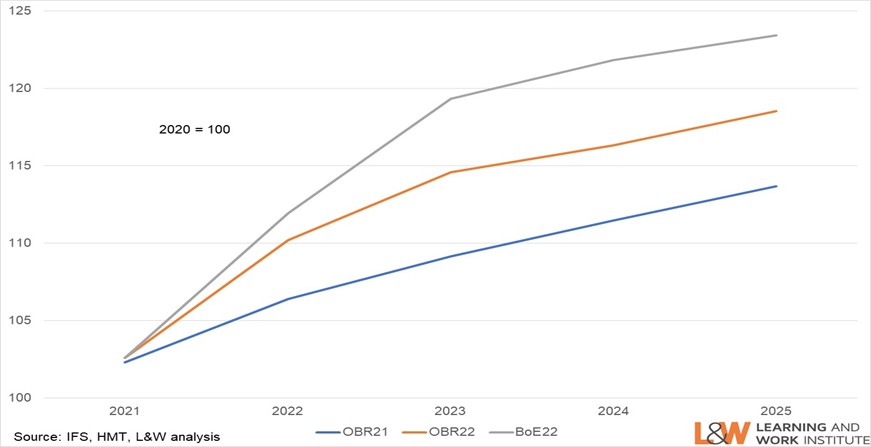
There have been significant rises in inflation since the Spending Review, partly resulting from the impact of Russia’s invasion of Ukraine. The Office for Budget Responsibility (OBR) updated its forecasts in March 2022 and the Bank of England did likewise in May 2022. The chart shows how overall price levels might vary each year compared to Spending Review projections The upshot is that prices may by 4.3-8.6% higher in 2024-25 than expected at the Spending Review. Clearly there is significant uncertainty over this, and rates of inflation experienced by different groups and sectors vary.
What would this mean for learning and skills funding?
If the Government doesn’t increase funding the total skills budget for England would be £370-850m lower in real terms over the three years of the Spending Review. The 2024-25 budget would be £120-350 million lower in real terms, wiping out up to one third of the planned rise in adult skills budgets in England. The Bank of England inflation forecasts would mean adult skills funding relatively flat in real terms between 2021-22 and 2022-23. Within these totals, the Adult Education budget and National Skills Fund would be harder hit, with apprenticeship funding somewhat cushioned by higher than expected employment and growth in nominal earnings.
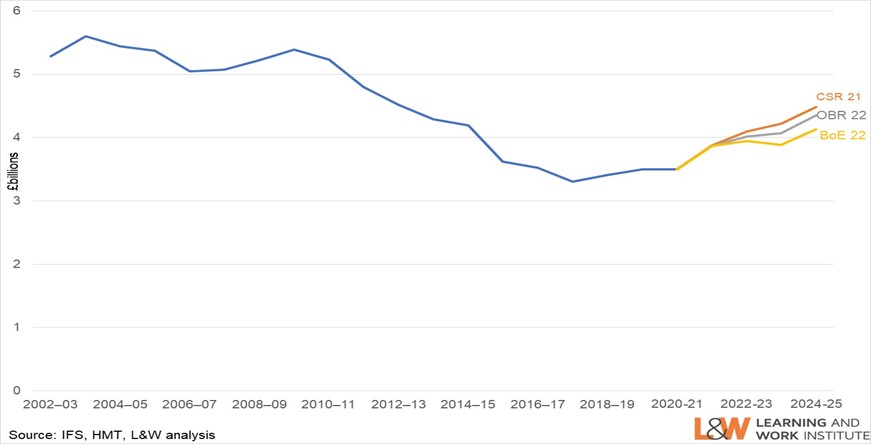
We estimate that total funding would be £870 million to £1.1 billion lower in real terms in 2024-25 compared to 2010-11. This compares to our estimate of £750 million at the time of the Spending Review.
The real terms rise of 29% in funding expected at the time of the Spending Review compared to 2019-20 would become a rise of 18-24%. The chart below shows how the 2024-25 skills budget in England would compare to 2010-11 and 2019-20 under different scenarios, inflation projects: at the Spending Review (CSR21); by the OBR in March 2022 (OBR22); and by the Bank of England in May 2022 (BoE22).
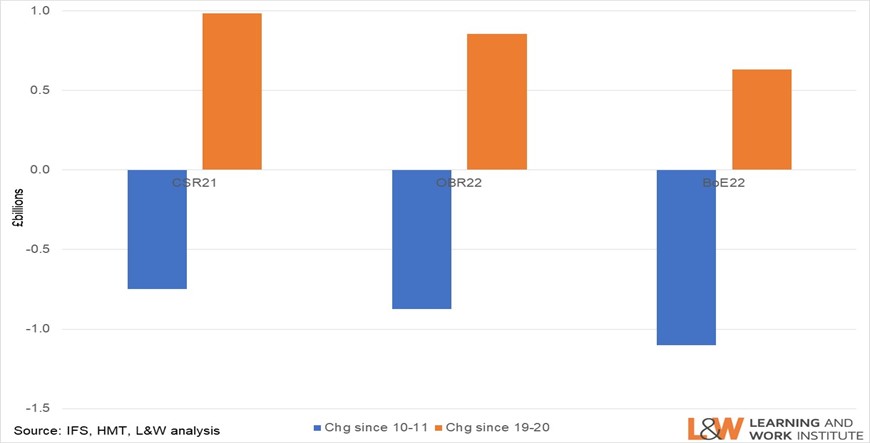
The chart below shows how much funding may be wiped out by higher than expected inflation.
What would this mean in practice?
The quality of learning or up to 250,000 learning places could be at risk over the next three years under the Bank of England inflation scenario which results in a cumulative reduction in real terms funding of £850 million over that period (based on an average £3,500 unit cost per learning – of course funding rates vary significantly by person, subject and level).
Without any compensatory increases in funding, one or both of two things would likely happen:
- Further pressure on providers’ budgets and the quality of learning. If funding rates per learner are not increased, providers will find it increasingly difficult to provide high quality learning. Difficulties paying higher salaries and increases in precarious work could lead to staff shortages. Larger class sizes might not work for some provision or some learners. Curriculum content could be limited. Some provision or learner support may be cut altogether. This could feed to lower than expected learner numbers and underspends in skills budgets.
- Reductions in learning numbers. If funding rates per learner are increased but no additional funding is provided, then fewer adults can take part in learning. This would leave rates of participation in learning even further behind 2010-11 levels than is already expected for 2024-25 and hold back economic growth which is essential for improving living standards.
Either option would put at risk the Government’s goals for levelling up and for its Lifetime Skills Guarantee. Our research shows how vital adult learning is for prosperity and fairness, but that progress improving our skills base has stalled over the last decade. Increasing economic growth will be essential to improving living standards and ensuring public services have sufficient resources – improving skills can contribute to that.
What should happen next?
Mitigating the impact of higher inflation on skills budgets would require an additional increase investment of up to £350 million per year by 2024-25, on top of existing planned rises. That would be an investment in our future that should pay off many times over.