Learning and Work Institute recently evaluated Welsh Government’s Healthy Working Wales: In-Work Support Service (IWS). The evaluation sought to glean key lessons from the project that focussed on South West and North West Wales ahead of a nation-wide rollout.
IWS was a Welsh Government and European Social Fund funded programme. It aimed to help people manage their health and stay in work. This was through early intervention, providing workers with rapid free access to a range of practical, personalised support and therapies to address barriers including mental health and musculoskeletal conditions. It also provided free advice, guidance, and training for employers so they could better support their workforce’s health and wellbeing.
IWS started in September 2015 with the aim of tackling poverty and social exclusion. The intervening years encompassing the pandemic, a cost-of-living crisis and a rise in labour market inactivity have made the need for a service that helps people stay in work ever more critical.
“We know that people in Wales are leaving the workforce because of ill health and disability, and that this is a class and gender issue with those who leave the labour market for health reasons more likely to be women working in low paying sectors. Effective in work support services are an essential part of addressing this inequality.”
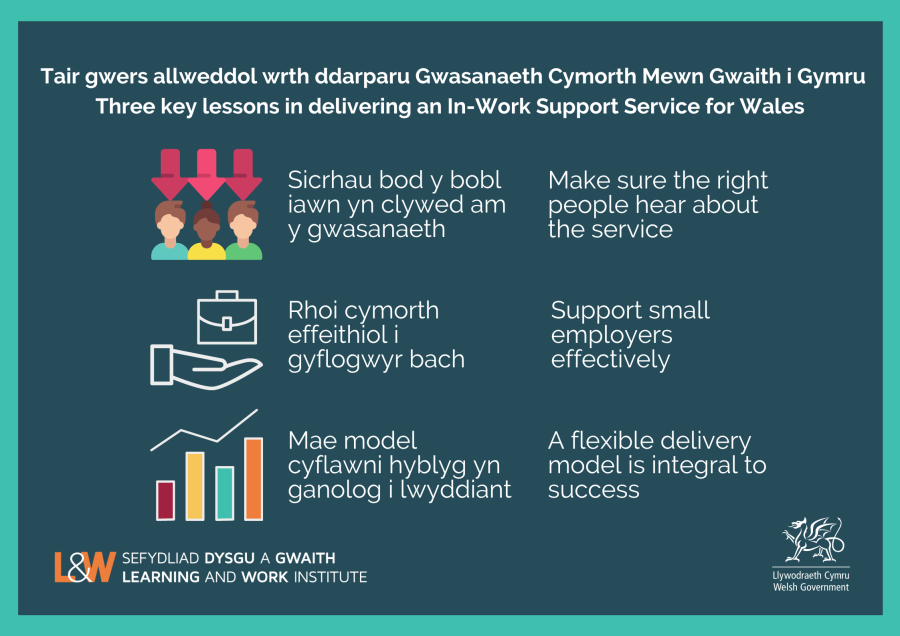
Our report outlines how participants and employers valued the service, and identifies important learnings for similar services. Three key lessons were:
1. A flexible delivery model is integral to success
The service offered a tailored support offer, and flexibilities including the number and frequency of sessions, whether the support was online or face to face, a choice of therapist, and a choice of language. The delivery model could be further extended by looking at wider participant needs such as domestic abuse or debt management, and building in more preventative activities such as well-being or stress management workshops.
2. Support small employers effectively
Small and medium enterprises are less likely to have resources such as Occupational Health services or HR to support employees’ health and well-being, and are particularly likely to benefit from support. This should include:
- Support with developing and implementing well-being strategies, action plans and wider HR policies,
- Support with embedding a focus on well-being in induction and staff performance and development review processes.
- Promotion of the individual support element of the service to employees
- Support to develop workplace wellbeing champions.
3. Make sure the right people hear about the service
Promotion of the service was a challenge and successful strategies to overcome could include:
- Consistent engagement of wider stakeholders and partners to reach both individuals and employers, such as the Federation of Small Businesses, Business Wales, Working Wales, Trade Unions, industry sector representative bodies, and third sector organisations.
- Integrating the individual and business elements of the service, so that engagement with employers can become a means of reaching individuals.
- Providing tailored information, support and resources for GPs and other healthcare professionals. Encouraging GPs to promote self-referral is likely to be more effective than GPs making direct referrals.
- Clear messaging to promote services to individuals including:
- The distinctive focus on supporting people who are in work
- The opportunity it offers to by-pass NHS waiting lists and gain rapid access to therapies
- The fact it is free at the point of access for participants.