
A key role and opportunity for Medr
The introduction of Medr, the Commission for Tertiary Education and Research has the potential to dramatically reshape approaches to promoting equity in tertiary education in Wales. There are several reasons to be cautiously optimistic about the new body and how it could transform the post-compulsory landscape.
The new body has attached to it various duties that give a strong sense of purpose. Beyond the duty relating to promoting equality of opportunity, these duties will all have a bearing on equity in tertiary education in some form and provide a strong starting rationale for Medr’s funding and regulatory policies. The challenge for Medr in this will be how to operationalise these duties and turn them from important sections of statute to action in the real world.
The existence of a body with the financial and regulatory oversight of all modes of provision (sixth form, further education, adult community learning, work-based learning and higher education) is itself a potential benefit. In practice, Medr can and should be examining issues such as equity thematically with a firm understanding of how changes to one element of the post-compulsory education and training (PCET) sector can have a positive (or negative) impact on another and how this could support progression for learners.
To take a real-world example, in 2021 Clare Palmer won the Essential Skills for Life Award at the Inspire! Adult Learning Awards. Clare left school with no qualifications and spent most of her working career as a hairdresser and care assistant. Between the ages of 14 and 41 she hadn’t engaged with formal learning, but returned to community learning to join maths and English classes. She persevered with her essential skills and after completing a Level 3 Diploma in Health and Social Care, Clare gained more self-belief and subsequently decided to take her passion for care a step further and apply to university to become a social worker.
That’s an example of how lifelong learning can change someone’s life, through adult and community learning, further and higher education. But Clare’s story is the exception not the rule. If Medr is to achieve its duty to promote equality of opportunity, then examples like Clare’s need to become a more common-place feature of our post-compulsory landscape and that means much clearer progression routes and stronger outreach and promotion efforts for both 16-25 year olds and adult learners.
Medr will have to manage two clear policy aspirations. The first, is perhaps obvious to all involved in the PCET conversation to-date and is largely reflected in the data analysis provided by WCPP/ADR Wales: to send school leavers off on the journey of life equipped with the skills, qualifications, and a sense of self that they need to fulfil their potential. There is growing evidence of inequity in access to and participation in PCET in Wales among school leavers based on a range of socio-economic factors.
Inequities in PCET in Wales
As the WCPP/ADR Wales analysis highlights, this is an area fraught with inequalities at the moment with the characteristics of learners varying significantly by types of qualification and the place at which the student undertake them. For instance, the proportion going to sixth form declines from 43% for those with no deprivation to 13% for those with 4 dimensions of deprivation. The inverse is true of FE colleges where we see an increasing prevalence of FE participation the more dimensions of deprivation a learner has.
There are also inequalities in participation between Wales and the UK more broadly. A recent Education Policy Institute Report (EPI) report in particular only serves to reinforce the specific challenges facing Wales. This research found that the proportion of 16-18 year-olds not in education, employment or training in Wales is on the rise (from 6% in 2021/22 to 11% in 2022/23), that participation in higher education at 18 is lower than other UK nations (30% vs 49% in Scotland), and that there is a large gender participation gap at HE with young Welsh men the least likely to go to university (24%).
While unacceptable, none of this is particularly surprising and many of these trends are likely to have existed for some time. The question then, is what can be done about these trends, for clearly opportunity in tertiary education is not at present equally distributed.
As the EPI report notes, identifying the ‘policy cause’ of disproportionate inequality of outcome in Wales is not an easy task. But the urgency of their conclusions should at the very least encourage Medr to take the issue seriously. If we are to tackle these inequalities then an honest look at the system as a whole will be needed, including constructive challenge on the impact of the last decade of hard budget choices on outcomes across the post-compulsory sector.
Adult education
The second policy aspiration Medr will need to manage is less talked about but equally important. That is in the words of the former Education Minister Jeremy Miles, to deliver a Second Chance Nation: where it’s never too late to learn. Translating such a laudable ambition into practical action is no mean feat. We’re all accustomed to an entitlement to education into our early adulthood, but the same entitlement is less apparent as we age.
Again, the legislation setting up Medr provides a clear steer for the new organisation in this regard in that a duty to lifelong learning sits at the very top of the Tertiary Education and Research (Wales) Act and section 94 of the legislation makes securing ‘proper facilities’ for education and training for eligible persons over 19 a duty for the first time.
This sounds like a subtle change but in practice has significant consequences. The previous legislation, the Learning and Skills Act 2000 only placed this duty on 16-19 provision which in effect meant that full-time provision in FE (largely 16-19 year olds) received better treatment when finances tightened compared to part-time provision and adult community education (19+). This is borne out by the participation statistics which show that while work-based learning and full-time FE numbers were largely static over the last decade, part-time FE declined from around 110,000 learners in 2012/13 to a low point of just over 42,800 in 2020/21 before recovering slightly in recent years. Similar trends are evident in adult community learning with 31,427 unique learners in 2012/13 and a low of 5,555 in 2020/21 before a slight recovery. Undoubtedly the pandemic had an impact on the severity of the lows, however the trend was downward across the decade and the recovery in recent years has taken us to pre-pandemic learner numbers, substantially below levels at the beginning of the last decade.
This change is important because inequality of access beyond the age of 19 is far less measured and understood. When the cohort is population-wide, understanding the reasons for learning (or not), the impact that learning has on individual outcomes and the prior experiences that shape learning preferences is incredibly difficult. We know from our own previous research that the trigger point for learning can often be complex and varies across socio-economic background and levels of attainment.
Learning and Work Institute publishes an annual Adult Participation in Learning Survey that can begin to answer some of these questions. The 2023 survey found that almost half of adults in the UK participated in some form of learning (49%), although this was lower in Wales at 41%. Interestingly, participation appears to have increased markedly in England, whilst remaining relatively static in the other nations. In line with previous surveys, age, social grade, labour market status, and the age at which respondents completed full-time education are all significant predictors of participation in learning.
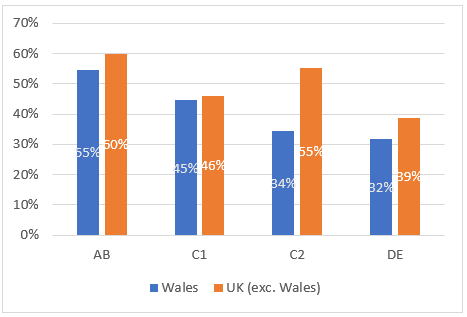
With respect to age, participation in Wales was lower in every age cohort although the gap narrowed as the cohorts aged with the larger gaps at younger age cohorts (17-19 where the gap between Wales & UK was 15%). There is a much clearer deterioration of participation by social grade or ‘class’ in Wales compared to the UK as a whole (see figure 1).
In essence, you’re least likely to be participating in adult learning if you left school with few qualifications, are on the margins of the labour market or in low skilled work.
Overcoming barriers to adult learning
Turning to barriers to learning, across the UK learners are most likely to identify work and time pressures (24%), the cost of learning (16%), lacking confidence to learn (13%), being put off by tests and exams (12%) or feeling too old (12%). While percentages may have increased, the pattern of reported challenges has seen little variation compared to previous surveys. Interestingly, a higher proportion in Wales (14% compared to 10% in the UK as a whole) cited disability or ill-health as a barrier to learning which highlights the overlap with health policy on learning (and employment) outcomes.
Turning this into practical policy action that Medr can pursue is a challenge but could include ensuring provision in Wales is flexible to meet work and time pressures, reducing the costs of learning particularly for those in lower social grades and ensuring the methods of learning are accessible, particularly at lower levels where self-confidence in learning is lower. Crucially, there needs to be a considered effort at awareness raising and promotion amongst disadvantaged groups with positive messaging tacking concerns around engaging with learning and reinforcing its benefits. These would also be important to help Medr meet its duty to promote lifelong learning, as previous WCPP work has argued.
There are likely to be other barriers that can be addressed by Medr beyond the limitations of the data in the Adult Participation in Learning Survey. It is therefore crucial that in developing its own capacity, Medr is able to generate a strong evidence-base upon which to make decisions on funding and regulation to tackle inequality of opportunity. It must also then put this into action in the way it commissions provision to take effect.
The Welsh Government has a strong policy commitment to lifelong learning with an ambition to create Wales as a ‘second chance nation’. The WCPP and ADR Wales reports provides a strong foundation for an evidence-based approach to this and I hope Medr is proactive early on in driving this agenda forward.