
Welsh Government has a welcome aspiration to make Wales a nation of second chances; with a policy landscape that supports lifelong learning and in particular adults returning to education. However, translating such a laudable ambition into practical action is no mean feat. We’re all accustomed to an entitlement to education into our early adulthood, but the same entitlement is less apparent as we age.
Learning and Work Institute has launched its annual Adult Participation in Learning Survey to coincide with Adult Learners’ Week 2024 in Wales this week – September 9-15.
Our survey shines a light on the current state of play for adults engaging with learning. The 2023 survey found that almost half of adults in the UK participated in some form of learning (49 per cent), although this was significantly lower in Wales at 41 per cent. Interestingly, participation appears to have increased markedly in England, while remaining relatively static in the other nations. In line with previous surveys, age, social grade, labour market status, and the age at which respondents completed full-time education are all significant predictors of participation in learning.
With respect to age, participation in Wales was lower in every age cohort than the UK as a whole, although the gap narrowed as the cohorts aged with the larger gaps at younger age cohorts (17-19 where the gap between Wales & UK was 15%).
The participation rate across the UK varies by social grade with the AB and C2 grades with the highest participation rate at 60 per cent and 55 per cent across the UK. By contrast, C1 and DE grades have lower levels of participation (46 and 39 per cent respectively). The distribution in Wales was lower for all social grades, but in particular there was a larger gap in the C2 grade (21 per cent lower than UK) and a low rate for those in the DE grade (at a participation rate of 32 per cent). There is therefore a much clearer deterioration of participation by social grade in Wales compared to the UK as a whole (see figure 1).
In essence, you’re least likely to be participating in learning if you left school with few qualifications, are on the margins of the labour market or in low skilled work.
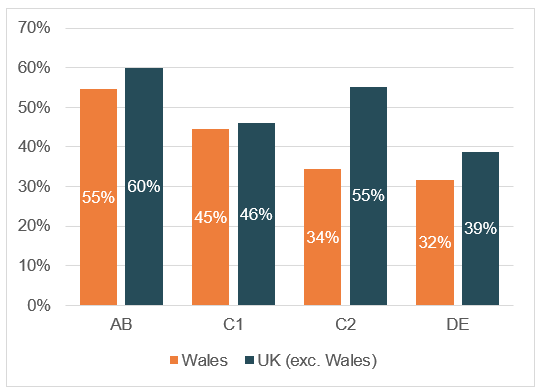
The survey measures several other demographic characteristics, with many similar across the UK (for instance employment type). However, to follow the thread of socio-economic disadvantage; addressing lower participation rates in learning, particularly at lower social grades is a significant challenge.
Most learners are motivated to learn for work or career reasons or for leisure or personal interest and see learning as a benefit in itself. It is also important for the value it adds to their work-based skillset and for self-confidence.
Turning to barriers to learning, across the UK learners are most likely to identify work and time pressures (24 per cent), the cost of learning (16 per cent), lacking confidence to learn (13 per cent), being put off by tests and exams (12 per cent) or feeling too old (12 per cent). The pattern of reported challenges has seen little variation compared to surveys across its 27-year history. Interestingly, a higher proportion in Wales cited disability or ill-health as a barrier to learning which highlights the overlap with health policy on learning (and employment) outcomes.
Turning this into practical policy action that Welsh Government and Medr can pursue is a challenge but could include ensuring provision in Wales is flexible to meet work and time pressures, reducing the costs of learning particularly for those in lower social grades and ensuring the methods of learning are accessible, particularly at lower levels where self-confidence in learning is lower.
There’s also potential for greater alignment between learning and health, something mirrored in the recent UK Labour manifesto that proposed Health, Work and Skills plans. Policies such as social prescribing could play an important role here.
Crucially, there needs to be a considered effort at awareness raising and promotion among groups who are perceived to be hard to reach with positive messaging tacking concerns around engaging with learning and reinforcing its benefits.
The data in our report highlights the gaps in participation that will need to be tackled to make the Welsh Government’s strong policy commitment to lifelong learning a reality.