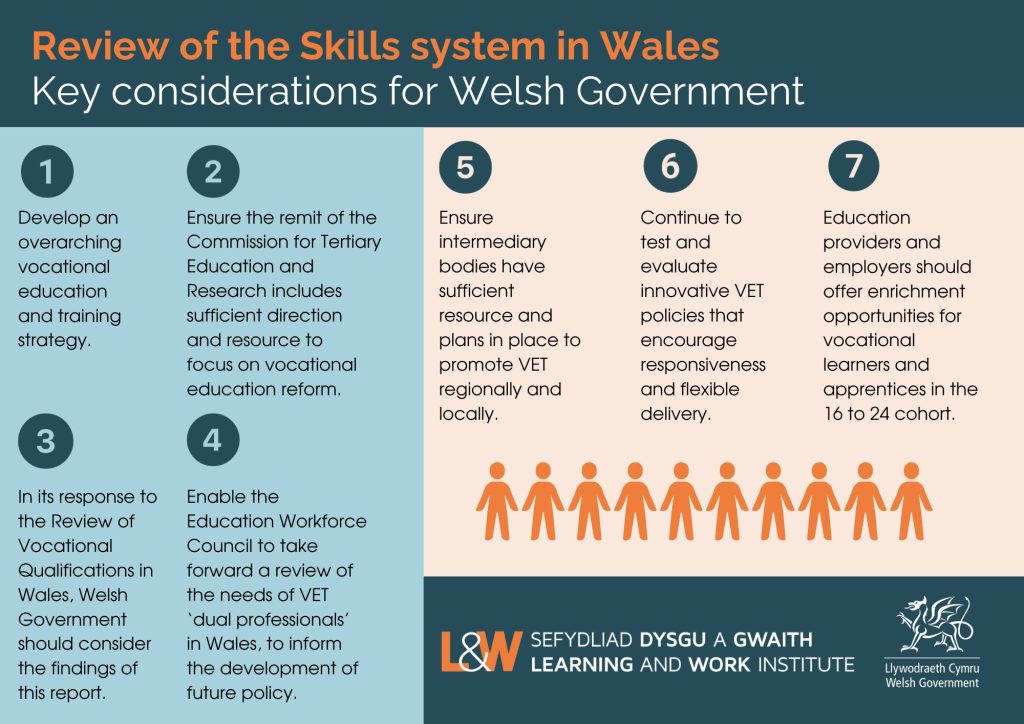
Learning and Work Institute was commissioned by Welsh Government in February 2023, to undertake a review of the skills system in Wales. This research was designed to be a thought piece to explore different visions for vocational education and training in Wales.
The review provided an overview of the evidence on establishing a cohesive skills system which differentiates Initial Vocational Education and Training (IVET) programmes, typically undertaken within the formal education system and during the transition to work and Continuing Vocational Education and Training (CVET) programmes, which are generally pursued after initial education and after entry into working life, for adults to acquire or improve their knowledge and skills and advance their professional development. The overview of the evidence was then tested with experts and sector representatives.
The impact of the pandemic and Brexit, high levels of economic inactivity, changes to UK migration policy, and wider societal change, including the development of new technologies, digitalisation, and transformation to net-zero have created new challenges and opportunities for the economy, labour market and skills system.
Given the changing landscape, it is crucial to examine the skills system to identify how skills training programs can effectively prepare individuals for the working world and support lifelong learning.
The research explored three key themes – the strategic and systemic aspects of VET; delivery and curriculum considerations; and the benefits and impact of VET.
Some of the main findings from the research included:
Strategic and systemic aspects of VET
- There are inconsistencies between the collaboration of employers and learning providers across Wales.
- The needs of the CVET cohort (25 years and over) are seen as largely different to IVET learners and apprentices.
- CTER has an opportunity to address some historical inequalities that affect both IVET and CVET.
Curriculum and delivery aspects of VET
- The flexibility of qualifications is crucial to enable an agile VET system.
- Both IVET and CVET play key roles in widening participation, access, and inclusion.
- The provision of well-informed and impartial career information, advice, and guidance is important for both IVET and CVET learners.
Perspectives on the benefits and impact of VET
- The positive impact of VET on the individual is the basis for wider social, employer, and economic impacts.
- The different needs of age cohorts lead to different priorities for each within the IVET and CVET cohorts.
- Employers are identified by stakeholders as a key beneficiary of both IVET and CVET.
- Transferable or transversal skills are a key element to measure as a mediator of impact.
Usually termed employment support, or sometimes employability or welfare-to-work support, these are interventions for people who need help finding or progressing in work. Employment support covers activities such individual coaching, employability courses, job clubs, careers advice and guidance, supported work placements and in-work support. Jobs hubs are another form of employment support. These are place-based initiatives which bring together employment support, skills, provision, and wrap-around services such as digital inclusion and wellbeing support.
In Wales, employment support is provided by a wide range of organisations, including Jobcentre Plus, programmes commissioned by the Department for Work and Pensions (DWP), Welsh Government, councils, colleges, social landlords and a range of for-profit and not-for-profit organisations.
Key research findings
- The employment rate in Wales is lower than in England and Scotland, as a result of higher rates of economic inactivity.
- Poor health and disabilities are the main cause of economic inactivity in Wales, with 146,000 people or 7.7% of the working-age population economically inactive due to long-term health conditions or disabilities in Wales, compared with 5.5% in England and 6.9% in Scotland.
- Employment support also has a role to play in addressing job insecurity and in-work poverty and making Wales a fair work nation that is responsive to changing employment patterns.
- Looking forward, Wales will need more workers with digital and green skills and a larger social care workforce. However, jobs may be lost through AI and automation. Employment support has a role in helping people change career and enabling communities to be resilient to economic shocks.
The potential of a reformed employment support system in Wales
The current employment support landscape is complex, with individuals having to navigate multiple programmes run by UK, Welsh and local governments and a significant number of agencies. Only one in ten out-of-work older people and disabled people in the UK get help to find work each year.
To address these issues, there needs to be a much closer partnership between the UK and Welsh Government. Learning and Work Institute is calling for a shared strategy to tackle economic inactivity. Drawing on international examples such as in Germany and the USA, the strategy should examine ways of working, including what is suitable for devolution to help drive stronger accountability and better outcomes.
Download the report