
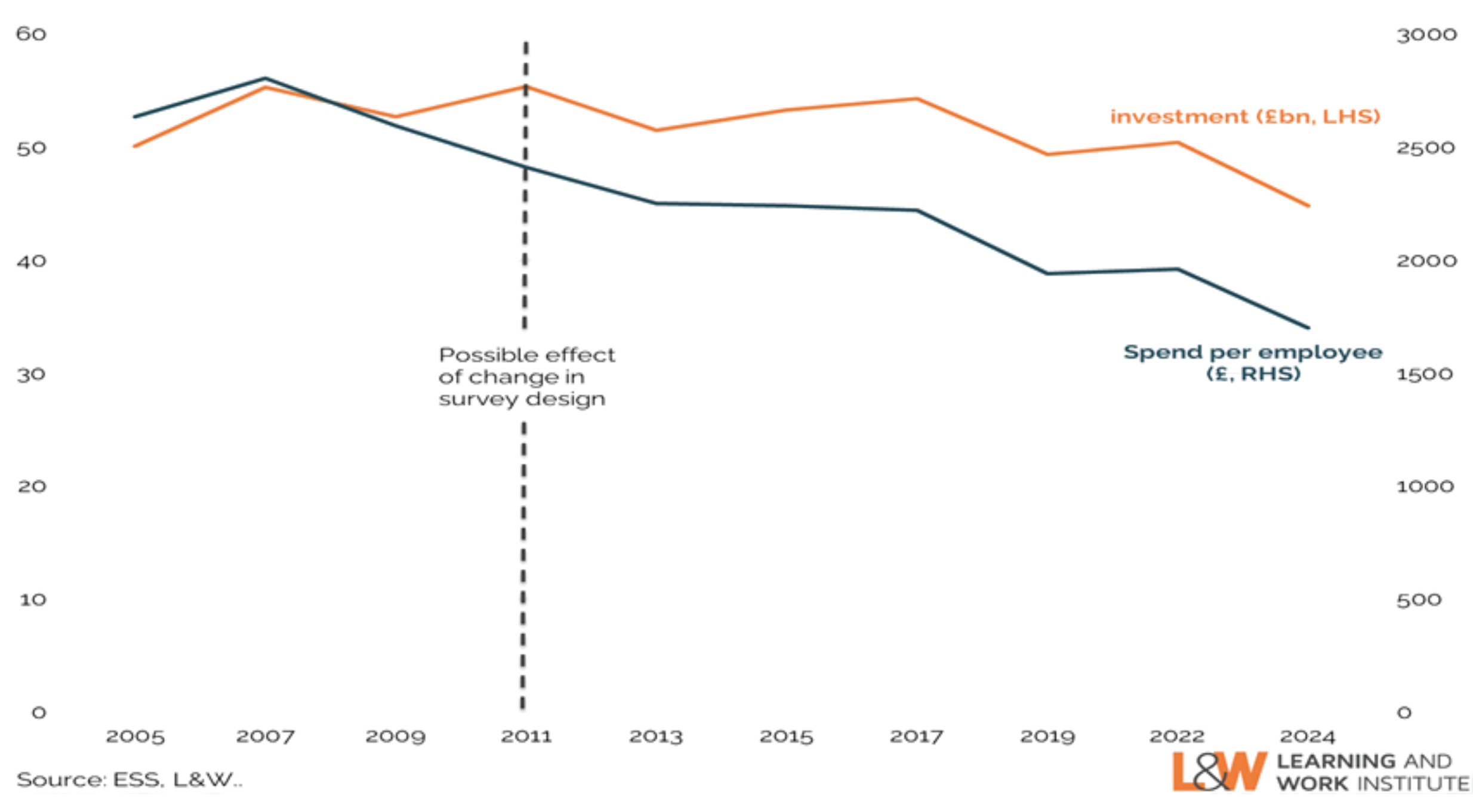
Employer investment in training continues to fall, now down 36% per employee since 2005. The biggest falls have been in public administration, hotels and restaurants, and health and social care. In addition, skills spending tends to be skewed toward already highly skilled people and often shorter and lighter touch than in other countries. This holds back economic growth.
The latest Employer Skills Survey shows further falls in employer investment in training
The 2024 Employer Skills Survey shows further falls, continuing the downward trend since 2005.[1] Since the last survey in 2022, employers are spending 13% less on training each employee. Since the introduction of the apprenticeship levy in 2017, intended to raise employer investment in training, training spend per employee (including the levy) is down almost one quarter (23%).
All told, L&W analysis shows employers are investing 36% less per employee in training in real terms than in 2005, £1700 per employee compared to £2634 in 2005.
Most sectors have seen a fall in training investment
Compared to the previous survey in 2022, the biggest falls in spending on training per employee were in public administration (-50%), financial services (-47%), information and communications (-30%), and health and social care (-26%). Only the primary sector and utilities (+11%), education (+3%), and transport and storage (+1%) saw rises.
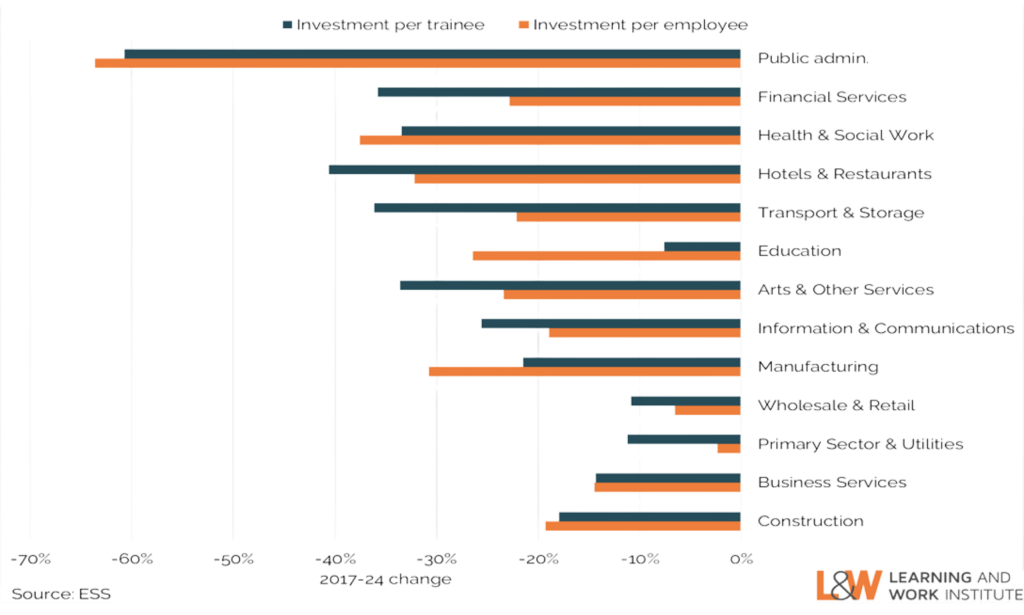
This continued the pattern of ongoing falls in investment across most sectors. Since 2017 (when the apprenticeship levy and other reforms were introduced) training investment has fallen in every sector. The biggest falls in investment per employee have been in public administration (-64%), hotels and restaurants (-38%), and health and social care (-32%).
Growth in cheaper online training may have contributed to recent falls in employer training investment. This is a good thing if employers are able to get the same or bigger impact from training for less cost. But it can be a bad thing if it means training is lighter touch and has less impact, becoming more of a tick box exercise. Spending per employee in the UK is half the EU average; it is possible UK employers are twice as productive in their training investments as those in other countries, but seems unlikely.
Training tends to be light touch and access unequal
Although 59% of employers said they offered training, this is down from 66% in 2011 and means four in ten employers offer no training at all. Looking at types of training, 19% of employers offer on the job training only, 11% offer only off the job training, and 29% offer a mix.[2]
Availability of training varies significantly by sector. Over four in five employees in education (88%) and health and social care (83%) offer training, but only one in two in primary sector and utilities (48%), construction (50%), manufacturing (51%), and wholesale and retail (53%) offer training.
The number of training days per trainee has fallen 10% since 2017, from 6.4 to 5.7. Previous L&W analysis has shown that graduates are three times more likely to get training at work than non-graduates and that UK employers spend half the EU average on training per person.
More people are getting training but it’s shorter and so risks having limited impact
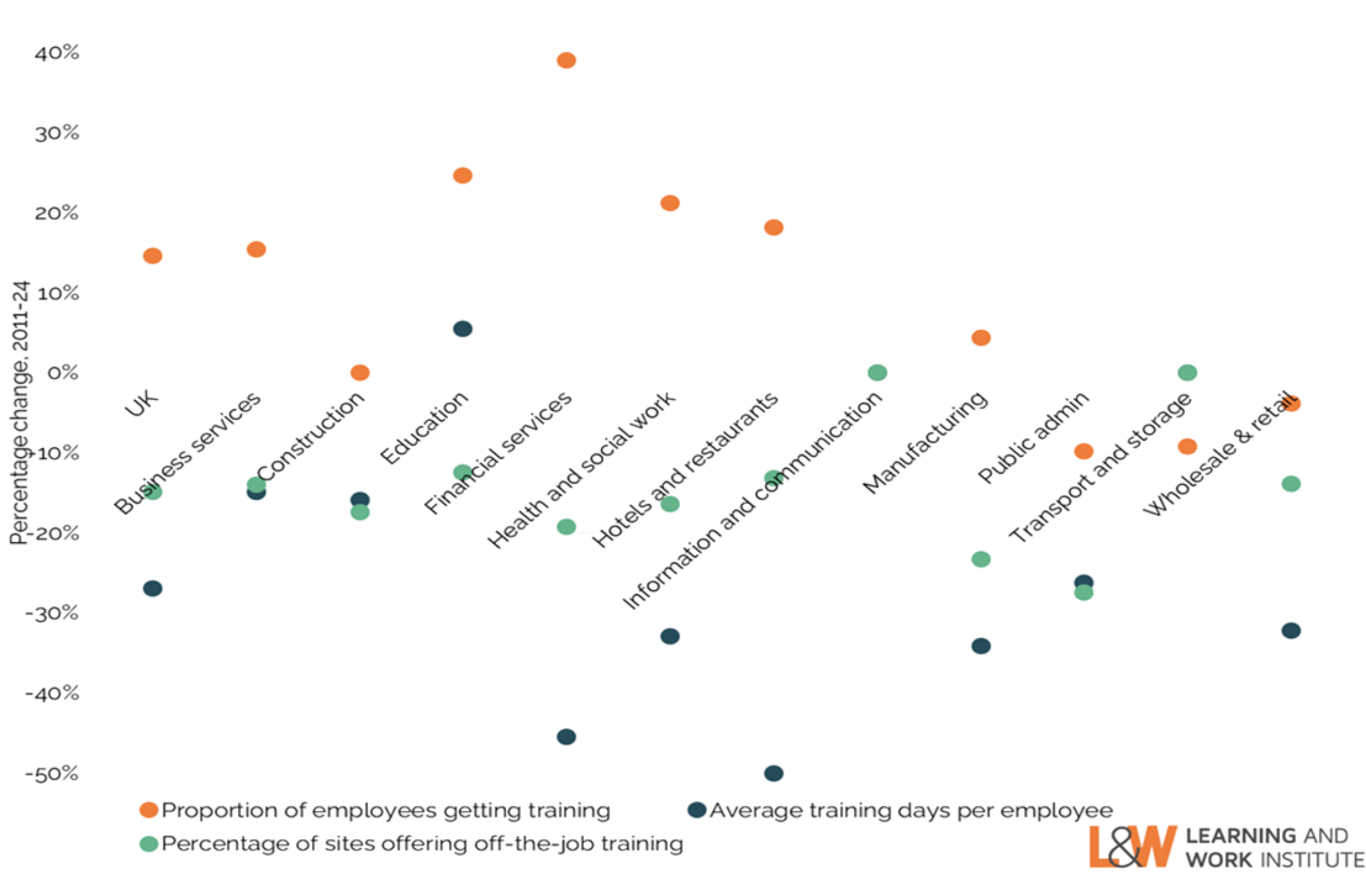
The general pattern between 2011 and 2024 is a higher proportion of employees getting training (with the exception of public admin, wholesale and retail, and transport and storage), but that training lasting less long, being cheaper, and being less likely to be ‘off the job’. Shorter and on the job training can be highly valuable. But the scale of this shift, combined with the UK’s relatively weak intermediate skills base and low productivity growth, suggests it is fair to be concerned how much impact this training is having, noting also that off the job training can be more transferable to other jobs.
This matters for economic growth and we must change it
There is a clear link between skills, productivity and individual opportunity. L&W research showed that doubling adult attainment of literacy, numeracy and level 2 and 3 qualifications, returning England to 2010 levels of skills improvements, could boost the economy by £23 billion per year. Separate L&W research showed that people in occupations like cleaners, labourers and waiting staff who get training at work get paid on average 15% more than those who don’t get training at work.
The drivers of low employer investment in training are varied and the subject of an L&W project funded by Nuffield Foundation. Poor economic performance since the global financial crisis along with regular crisis and political uncertainty will have contributed given that employers invest in training to help meet their business needs – fewer opportunities for growth will mean less investment in training.
But in addition, incentives for firms to invest in training, particularly for lower-skilled workers, are often insufficient. This is especially the case where businesses have a high labour turnover, low productivity business model, or where they are concerned that rivals may poach newly trained workers. To tackle this L&W has previously argued for a Skills Tax Credit to reward businesses that invest in skills, flexing the apprenticeship levy so that firms can invest in the skills they need, and supporting ways for firms to act together to invest in skills (building on the existing levy in the construction industry). All of these approaches need to be based on a clear business case and easy to access system.
[1] The Employer Skills Survey is commissioned by the Government and in 2024 surveyed 22,712 employers across the UK, with a follow up investment in training survey with 5,935 employers.
[2] On-the-job training is training at the individual’s work position and covering activities that would be recognised as training by staff, rather than learning by experience. Off-the-job training is training beyond that which takes place on-the-job or as part of an individual’s normal work duties.