Thomas Heiser, Head of Communications at Ufi VocTech Trust, reflects on the findings of the Adult Participation in Learning Survey 2024 in relation to learning with technology.
Whether for individuals looking to gain and maintain their skills for work, industries tackling growing skills gaps, or the UK economy striving for increased productivity, vocational technology (technology that helps develop skills for work) is the key to opening doors of new opportunity.
For more than 25 years, Learning and Work Institute’s Adult Participation in Learning Survey has provided insights on who’s learning and how they learn. And for the second consecutive year, Ufi have supported the inclusion of specific questions on the use of technology.
With technology becoming increasingly integral to how we learn, supporting the growing evidence base on the use of technology in adult learning is crucial. At a time of growing skills shortages holding back people, industry and regions across the UK, gaining a deeper understanding of whether adults are using technology in their learning, the types of technology being used, and the benefits they experience has never been more important.
We hope that the findings in this year’s survey can help to support the continued development and adoption of the very best vocational technology, building a more inclusive, thriving future in which everybody benefits.
Discover the Adult Participation in Learning Survey 2024
Read the reportUse of technology to learn
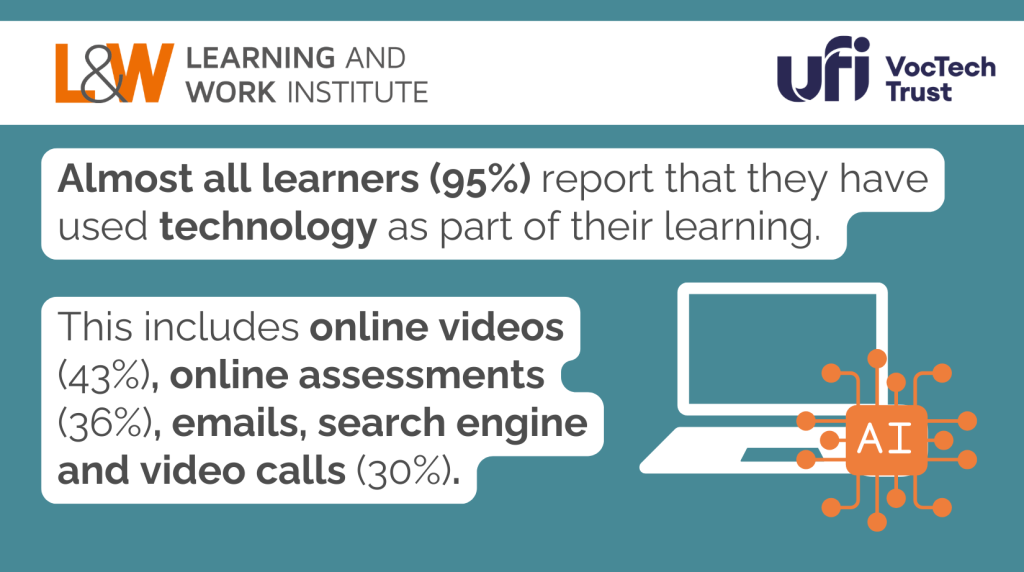
From a representative sample of around 5,000 UK adults, it remains clear that technology and learning are deeply entwined. 95% of adults in the 2024 survey report using technology in their learning across both formal and independent settings.
95% of adults in the 2024 survey report using technology in their learning across both formal and independent settings.
There continues to be a wide range of technologies used to support adult learning, including online videos (43%), online assessments (36%), emails, online search or video calls (all 30%).
As may have been expected, a significantly higher proportion of adults have reported using artificial intelligence e.g. ChatGPT in their learning this year (14% in 2023 and 18% in 2024). While newer technologies such as AI and virtual reality are still being used by a minority of learners, these numbers are not insubstantial. As a sector we must continue to monitor their use and impact and share best practice where we see it.
How is technology supporting adult learning?
Not only is technology being used in learning, but almost all learners (98 per cent) who have used technology to support their learning identify at least one benefit of doing so.
Almost all learners (98 per cent) who have used technology to support their learning identify at least one benefit of doing so.
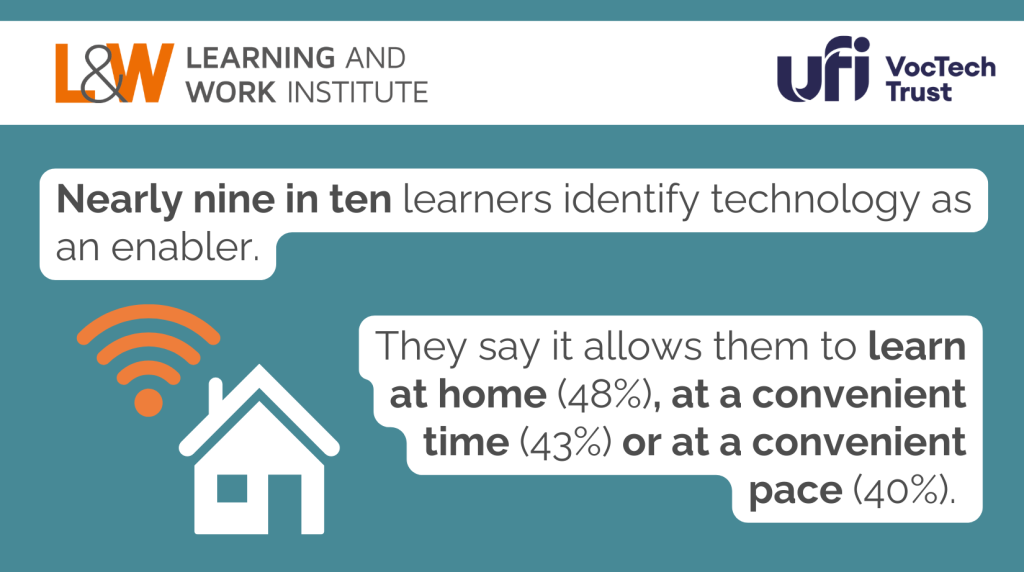
Nearly nine in ten learners (86 per cent) identify benefits in which technology is an enabler; for example, allowing them to learn at home (48 per cent), at a convenient time (43 per cent) or at a convenient pace (40 per cent). In addition to enabling adults to learn, technology is also aiding or enhancing the learning experience, including by making learning more interesting or engaging (28 per cent) or increasing confidence (24 per cent).
It is important to note that this is not the case for all adults. While two-fifths (79%) of adults who have not learned in the past three years or have not used technology to support their learning identify at least one benefit technology could bring, most commonly these related to convenience, including being able to learn at home (48 per cent), at their own level and pace (43 per cent), and at a convenient time (40 per cent). Potential benefits to the learning experience were reported much less frequently, making learning more interesting or engaging (21 per cent) and increasing confidence (18 per cent).
Talent is everywhere but opportunity is not. This is why Ufi have a particular focus on unlocking potential for learners furthest from opportunity, helping ensure everyone is included and nobody is left behind. The survey findings show that as a sector we must continue to promote the benefits of learning technology to those who are currently disengaged from learning and those not currently using technology as part of their learning.
We must continue to promote the benefits of learning technology to those who are currently disengaged from learning and those not currently using technology as part of their learning.
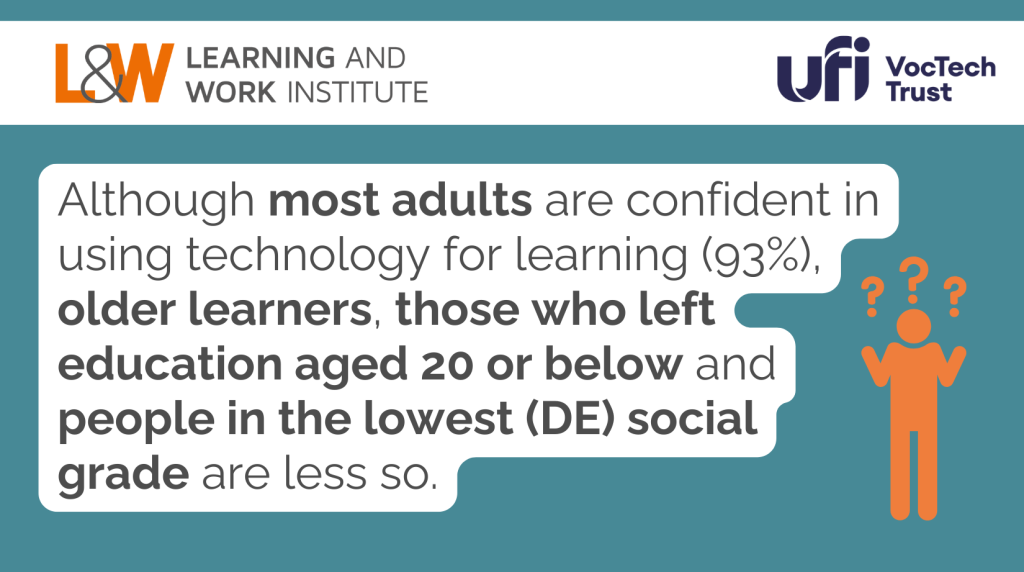
Confidence in using technology
As seen in last year’s survey, adults are generally more confident in using technology in their daily lives than for learning or at work. 97% are confident using at least one kind of technology in their daily lives, compared to 93% for learning and 85% at work. These findings illustrate a continued need to provide structured guidance and support when technology is used for learning or at work, even when using technology that adults may be confident in using for their daily lives. This is reflected across many of the projects we support through our grant funding and investments. Technology alone is not enough. Truly transformative learning technology can only be developed from a deep understanding of learners and the personal experiences they bring to their learning.
Truly transformative learning technology can only be developed from a deep understanding of learners and the personal experiences they bring to their learning.