


Every month, Learning and Work Institute produces detailed and timely analysis of the latest labour market statistics from ONS. We examine what the figures tell us both about the health of our labour market, and what they mean for people’s experiences of work, with a particular focus on groups facing labour market disadvantage. Become a supporter to receive our monthly briefing delivered directly to your inbox and navigate our labour market dashboard.
November 2026
Dr Helen Gray, Chief Economist at Learning and Work Institute, said:
With recommendations from the Milburn Review hot off the press, today’s labour market figures provide a timely reminder of the scale of the problem to be addressed. Around a million young people are not in education, employment or training (NEET) – a level not exceeded since 2013. Moreover, help is currently targeted at those on unemployment-related benefits, leaving three in four NEET young people with little support to progress into education or work. They are also hampered by the ongoing decline in employment opportunities in hospitality and retail, where young people often gain their first experiences of work. The number of jobs in these sectors has declined by 140,000 over the past year. The Milburn Review needs to result in action to tackle the factors that constrain employment opportunities for young people, as well as ensure every young person has access to the support they need to enhance their future prospects.
This month, the release of the labour market statistics coincides with the final report from the Milburn Review on young people and work. We’ll need to wait until next week for the latest figures on young people not in education, employment or training (NEET). But this month’s labour market data already give us a strong sense of the scale of the challenge and the prospects for improving outcomes for young people.
The Milburn Review sets out a bold ten-year ambition: to end long-term youth unemployment and reduce the UK NEET rate to 5%, putting the UK among Europe’s best performers on youth participation. At the heart of the recommendations is a new local Youth Opportunity Service, bringing together employment, careers, health and practical support around the needs of individual young people. It also recommends two new guarantees: an Opportunity Guarantee, ensuring access to education, training or work, and a Support Guarantee, providing the help needed to take up those opportunities.
However, the Review is also clear-eyed about the scale of the task. It recognises that these reforms would be delivered in a weak labour market and estimates that, even if fully implemented, they are likely to reduce the NEET rate to around 6.8% by 2036, still some way short of the 5% ambition.
Today’s labour market statistics reinforce that assessment. There have been some positive signs, with the employment rate rising to 75.4% in the July to September quarter, up slightly from both the previous quarter and a year earlier (75.1%). But one quarter does not make a trend. Vacancies continue to fall, earnings growth has slowed, and many employers remain cautious about hiring, particularly smaller businesses facing higher recruitment costs.
These conditions will have an impact on how far and how fast the government is able to go towards the ambition set out in the Milburn review. When vacancies are falling and employers are more hesitant to recruit, opportunities become harder to access, particularly for those seeking their first job, returning to work after a period of economic inactivity, or managing a health condition.
The Milburn Review sets out a compelling vision for strengthening support for young people, but its success will depend not only on helping people prepare for and access work, but also on employers creating opportunities for them to move into. Improving employment outcomes requires action on both sides of the labour market: effective support for those seeking work, and sufficient availability of good-quality jobs. Without progress on both fronts, there is a risk that the labour market remains relatively stable for those already in employment while becoming increasingly difficult to enter for those on the outside.
This month we explore what the latest labour market statistics tell us about the availability of jobs, why young people are finding it harder to get into work, and the latest release on the disability employment gap.
At the headline level there is little change
As always, we start with the big picture. And with the caveat that we need to be cautious about relying too heavily on the LFS, due to issues with the low response rates since the pandemic creating greater uncertainty in the numbers.
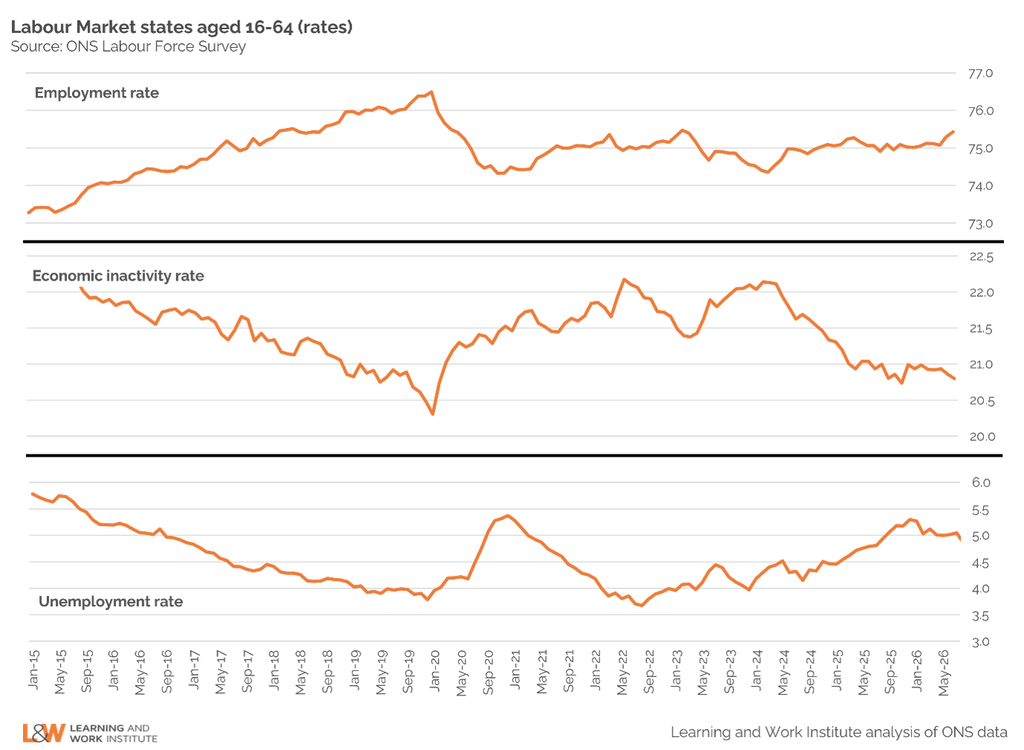
The employment rate for people aged 16–64 was 75.4% in July-September 2026, up slightly on both the previous quarter and this same period last year (both 75.1%). The unemployment rate was 4.8%, down slightly on the previous quarter (5.0%), while economic inactivity was virtually unchanged at 20.8% (down by 0.1 percentage point on the previous quarter).
We cannot assume much from this quarter’s improvements. The longer-term picture continues to be one of gradually weakening labour market performance, with both unemployment and economic inactivity remaining above their pre-pandemic lows and having trended upwards over recent years.
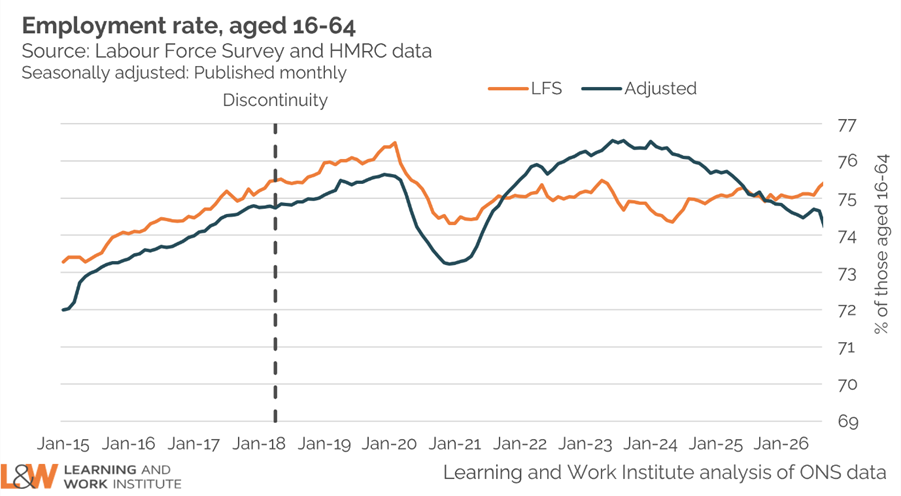
The chart above sets out the LFS employment rate alongside an adjusted employment rate derived using the administrative data (we base our methodology on one developed by the Resolution Foundation). Comparing the two reveals some differences, the Labour Force Survey shows employment stagnating after a small post-pandemic recovery, with a dip in 2023/24. The adjusted trend shows a much stronger post-pandemic recovery – but one that subsequently experienced greater deterioration in recent years.

The growing challenge of youth employment
In a weak labour market, young people are often hit hardest. This presents a significant challenge for the Government’s ambition, set out in the Milburn Review, to dramatically reduce the NEET rate.
The scale of the challenge is clear, we have nearly one million young people who are NEET and, despite a significant focus on the issue, youth employment has fallen compared with the previous year.
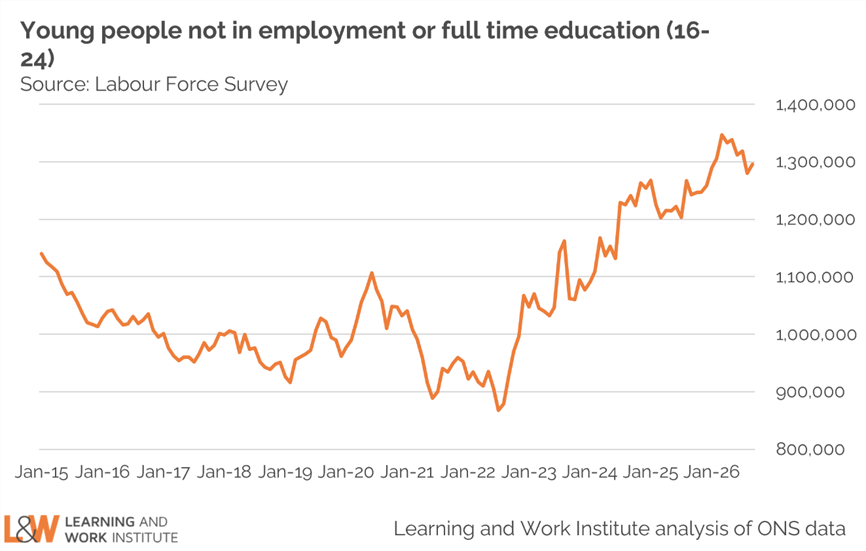
These trends reflect a combination of factors. Some young people struggle to find work in a labour market with fewer opportunities, while others face additional barriers linked to health, disability, skills or access to support. At the same time, the sectors that have traditionally provided many young people’s first jobs have become less likely to be recruiting.
This is not a new problem. NEET rates in the UK have been higher than those in many of the best-performing countries for at least 25 years. The Milburn Review aims to reverse that trend and make the UK a leader, rather than a laggard, on youth participation.
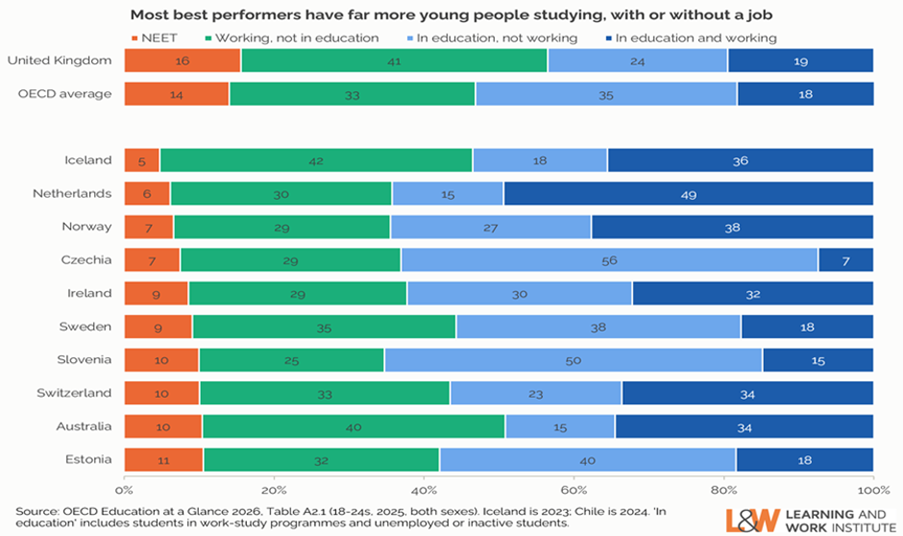
Looking internationally, the countries with the lowest NEET rates tend to have more young people in education, more young people in work, and more opportunities to combine the two. By comparison, the UK has a relatively high proportion of young people who are working but not studying, and a relatively low proportion participating in education. In the chart below, we’ve used OECD data to show that in the UK just 43% of 18-24 year olds are in education (including those combining study with work), compared with an OECD average of 53%.
For greater insights into what sets the best performing countries apart, you should head over to the Substack of our Chief Executive Stephen Evans for commentary and incisive analysis. He most recent article dives into what sets these higher-performers apart, and how the UK measures up.
Research from King’s College London and the Edge Foundation highlights a growing gap between aspiration and opportunity. Their study found that, only 16% secured an apprenticeship and just 23% were in stable employment by age 19-20. Even when young people found work, only half were on permanent contracts, down sharply from 81% six years earlier.
Taken together, the evidence points to a challenge that goes beyond individual employability. As the Milburn Review argues, tackling youth unemployment will require not only better support and guidance, but more routes into good jobs, training and progression.
Ill-health remains a major barrier to work
The latest figures show little progress in closing the gap between the employment rates of disabled and non-disabled people. In July to September 2026, 54.4% of disabled people were in employment, up from 53.0% in the previous quarter. By comparison, the employment rate for non-disabled people was 82.7%, leaving a disability employment gap of 28.3 percentage points.
While this is an improvement to the disability employment gap over the last quarter and last year, there has been little change over the longer term. The disability employment gap is smaller than it was before the pandemic, but progress has largely stalled over the last six years.
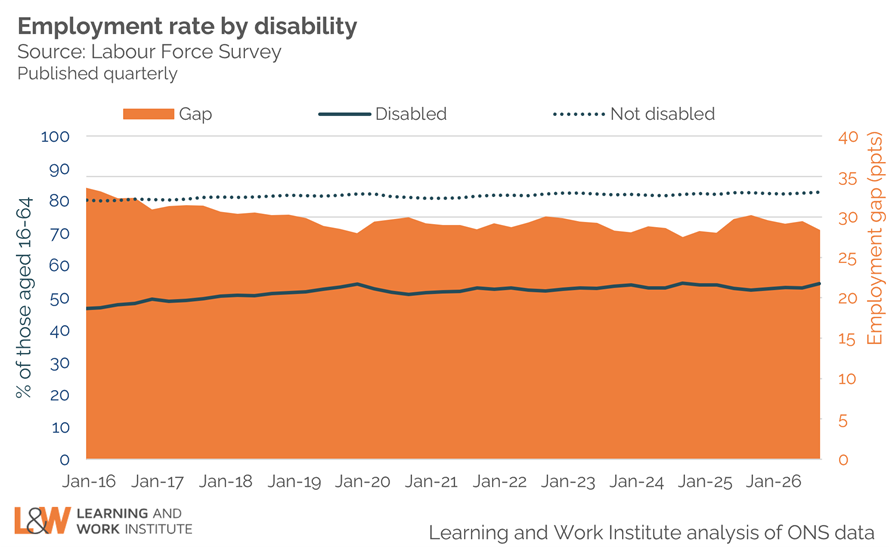
The persistence of this gap was highlighted by the Keep Britain Working Review, which examined the role employers can play in reducing health-related economic inactivity and creating healthier, more inclusive workplaces.
Today’s figures underline the scale of the challenge. Alongside the 539,000 disabled people who are unemployed, there are a further 720,000 people who are economically inactive because of long-term sickness but say they want a job. Together, these figures point to a significant pool of untapped talent that remains disconnected from the labour market.
The Milburn Review is clear that health has become a central factor in the UK’s youth participation challenge. Disability rates among young people who are NEET have more than doubled over the past 15 years, and more than half of NEET 16-24 year olds now report a health condition.
Nearly three in ten (28.4%) NEET young people cite disability or ill health as their main reason for not being in education, employment or training. The Review also highlights a shift in the nature of these health challenges. Between 2011 and 2025, the proportion of disabled NEET young people reporting mental health as their main condition increased from 24.3% to 42.6%.
These findings underline why reducing youth unemployment cannot be separated from improving health support. Helping more young people into work will require not only employment and skills programmes, but better support for the mental health and wellbeing challenges that are increasingly keeping them out of education and employment.
A longer-term decline in opportunities for people to move into
Trends in recruitment and entry-level opportunities are meaning fewer opportunities for anyone looking for work, which has a disproportionate impact on young people.
Vacancies are continuing to fall, and there are 5.4 people out-of-work and wanting a job for every vacancy. Vacancies dropped by 3.0% in the August to October quarter of 2026 – down to 690,000. This is following a slow but continuous decline in vacancies since the post-pandemic peak of nearly 1.3 million in 2022.
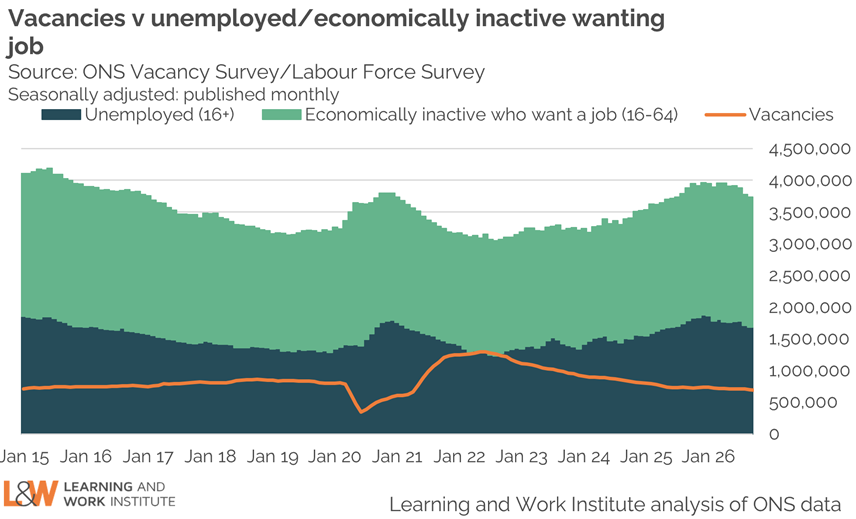
The fall in vacancies reflects growing caution among employers. Uncertainty about the economic outlook, combined with concerns about rising costs, has led many businesses to take a more restrained approach to recruitment.
Importantly, this does not appear to be a labour market downturn driven by large-scale job losses. The Bank of England has noted that the labour market is cooling primarily through weaker hiring rather than increased firing. Redundancy levels have remained relatively stable and, according to the Labour Force Survey, the redundancy rate is broadly in line with its pre-pandemic level. Instead, employers have largely adjusted by reducing recruitment activity, with vacancies and other measures of labour demand bearing the brunt of the slowdown.
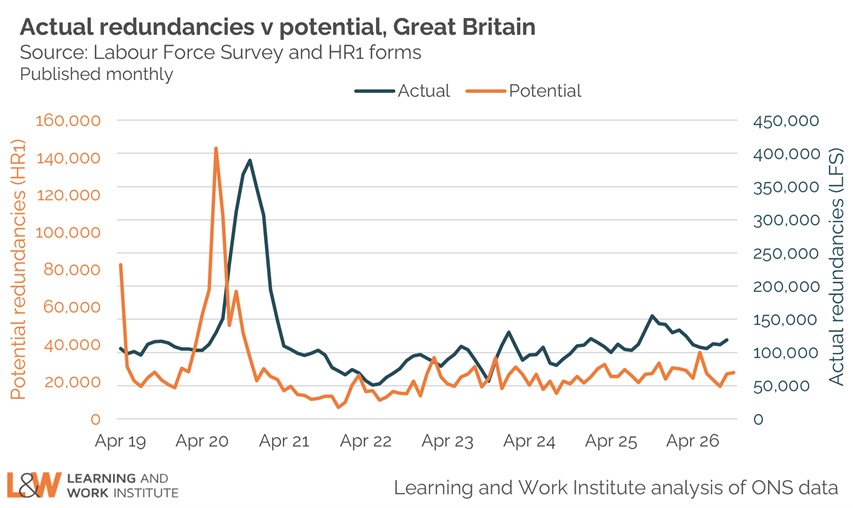
This is echoed by KPMG and REC, which point towards a more cautious recruitment environment. The number of people placed into permanent jobs across the UK fell for the first time in four months in October, according to the latest UK Report on Jobs survey, alongside an increase in the availability of candidates. This suggests that the challenge is not simply a lack of suitable applicants.
This approach is showing up in a falling number of payrolled employees, which we will explore in the next section.
Fewer opportunities in sectors that traditionally provide a first step into work
Achieving the ambitions set out in the Milburn Review is not simply about helping more young people into work. It is about ensuring they can access good-quality opportunities that provide a foundation for long-term employment, skills development and career progression. That means action on both sides of the labour market: supporting young people to prepare for work, while ensuring employers continue to create and recruit into entry-level roles.
However, recent labour market trends suggest this is becoming more difficult. Many of the sectors that have traditionally provided a first step into employment are seeing recruitment activity slow, reducing the opportunities available to young people entering the labour market.
Vacancies fell in 11 of the 18 industry sectors over the latest quarter, with the largest declines seen in administrative and support services, construction, and transport and storage, each recording 5,000 fewer vacancies. This points to a broad-based easing in labour demand rather than weakness concentrated in a small number of industries.
Retail and hospitality have long offered accessible routes into employment for young people, particularly those combining work with education or seeking their first full-time role. As recruitment slows, these opportunities are becoming scarcer.
The changing pattern of employment also differs by age. Between October 2025 and October 2026, the number of payrolled employees aged 18 to 24 increased (by 58,000) for 25 to 34 year olds fell (by 151,000), while the number aged 65 and over increased (by 71,000).
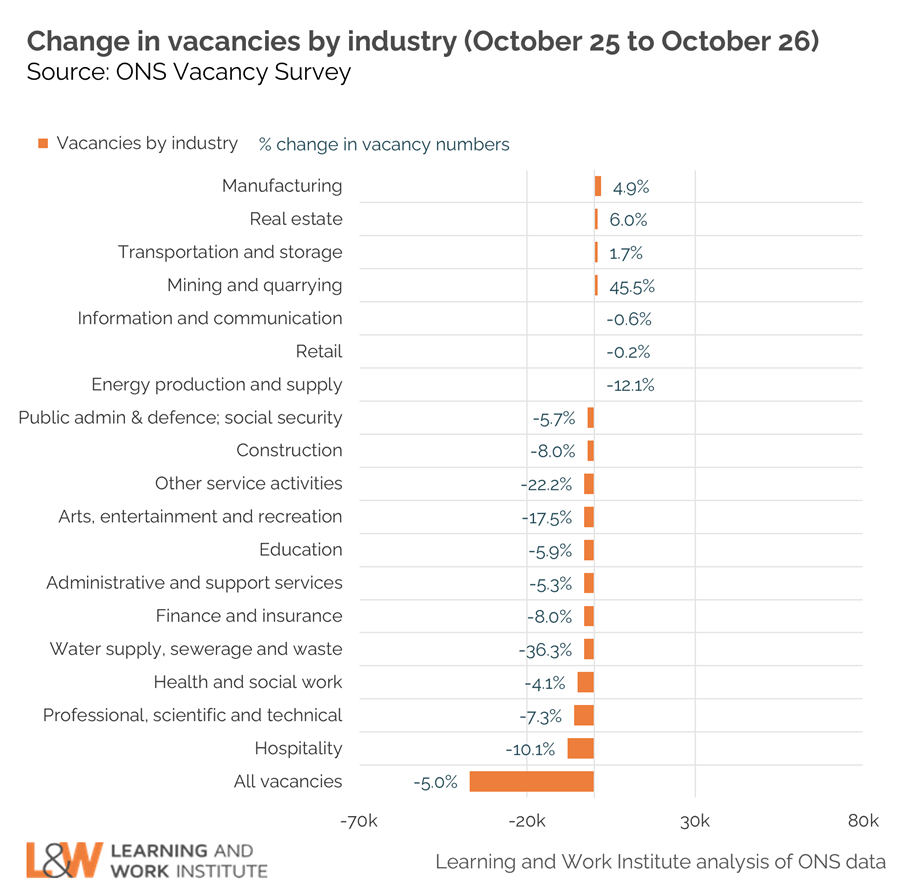
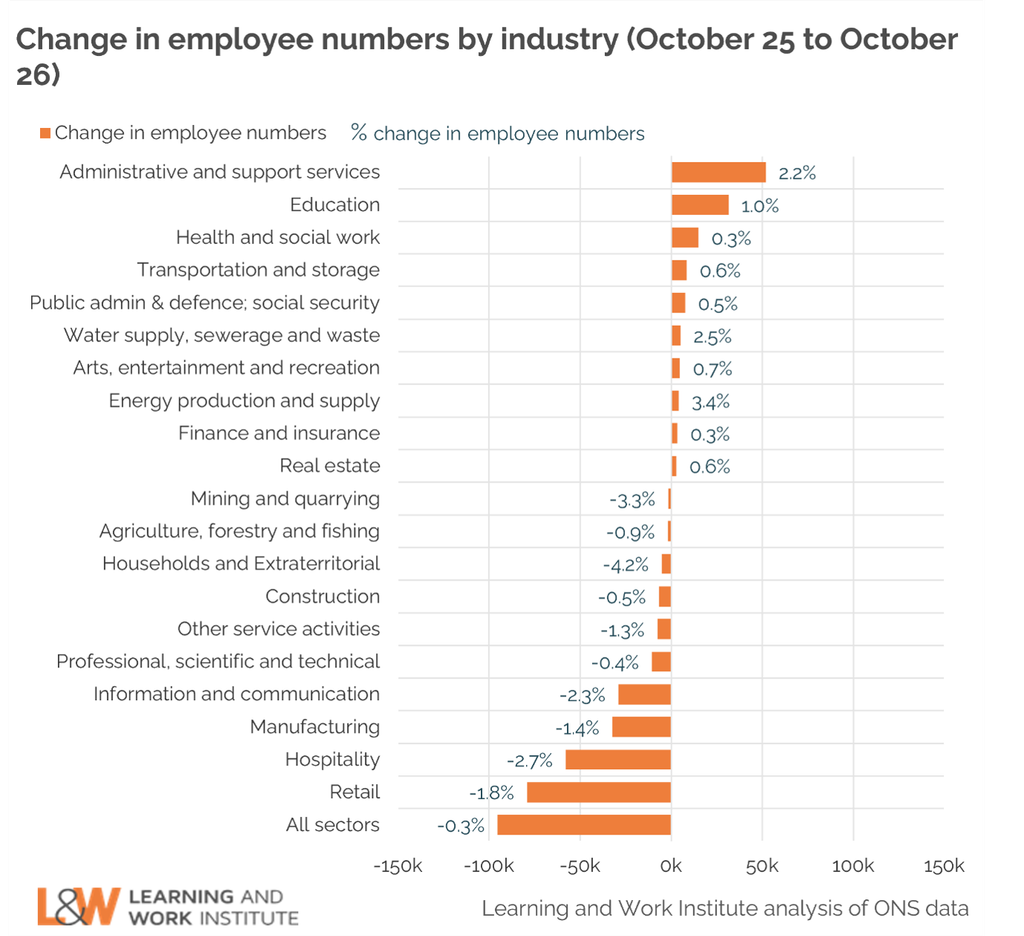
Access to early work experience has long-term consequences. First jobs help people build skills, confidence and a track record with employers. When these opportunities become harder to find, the journey from education into employment becomes more difficult.
Employers therefore have a crucial role to play. As candidate availability rises and vacancies fall, there is a risk that recruitment increasingly favours experienced applicants. Expanding access to apprenticeships, work experience and entry-level roles will be essential if more young people are to get a foot in the door. Otherwise, a labour market that looks stable on the surface may become increasingly inaccessible to those trying to enter it for the first time.