
The new Youth Guarantee could mean better help for over 300,000 18–21-year-olds, with metro mayors playing a leading role joining up support. But the guarantee should build over time to include all 16–24-year-olds and invest in new forms of support.
Back in 2018, Learning and Work Institute’s Youth Commission argued for a Youth Guarantee, so every 16–24-year-old in England is offered a job, training place or apprenticeship. Fast forward six years and the new Government committed to a Youth Guarantee in its manifesto.
This matters because time out of work and education when young can have long lasting effects on your career prospects. So for the sake of young people, the wider economy, and also employers trying to fill their vacancies, we need to do better and ensure every young person can access the education and career they need.
The Government’s Youth Guarantee will be focused on 18–21-year-olds. We know that around 300,000 in this age group are out of work and claiming Universal Credit. Some more will be claiming other benefits instead and others will be out of work and education but on benefits. However, both these numbers are falling over time as Universal Credit rolls out.
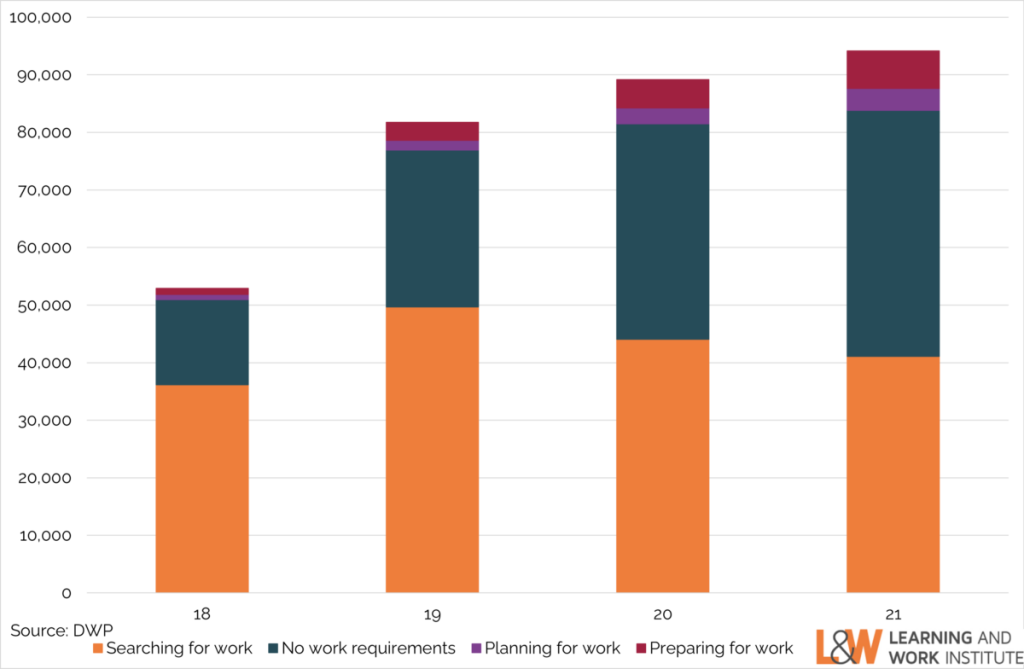
Of these, over one half (171,000) are in the Searching for Work group: they are required to look for work already. Will their support continue as is, or will they be offered extra opportunities around education or apprenticeships (with the expectation they have to take up one of the options)?
Most of the rest (122,000) are in the No work requirements group. They are mostly people who’ve been assessed as too ill to work and is one of the faster rising groups since the pandemic. There’s a further 15,000 in the planning or preparing for work groups, generally those either too ill to work now but well enough to prepare for work or with caring responsibilities for a young child.
At least some young people in this group might welcome the chance to start to prepare for work by, for example, taking a training course. How will they find out, though, about these opportunities? My assumption is DWP and other partners will do more to make sure young people in this group are aware of their opportunities, but with no consequence (such as a benefit sanction) if they don’t take it up. And that local partners, such as colleges and training providers, may be asked to do more to make sure accessible and flexible courses are available to suit their needs.
Making it happen
This leads on to the question of how to make any of this happen. At the moment, there’s lots of schemes, but no plan or long-term investment. The result is that some young people don’t get the help they need and some fall between the cracks altogether.
Labour has spoken in opposition and in government of the need for local government, particularly metro mayors across England, to take a lead in joining up support. So we might see mayors taking the lead in getting local employers and providers together and agreeing a plan for how to engage young people and make sure they get offered the right support. DWP will need to work with governments in Wales and Scotland who already have Youth Guarantees.
There will also need to be policy changes. Youth apprenticeships have fallen sharply since 2017 and the Government has already said it wants to change that. Funding for Further Education drops at age 18 and there’s no Pupil Premium at 16-18. Our Youth Commission also argued for a Job Guarantee – subsidised jobs like Kickstart and Future Jobs Fund – for young people who spend more than two years out of work.
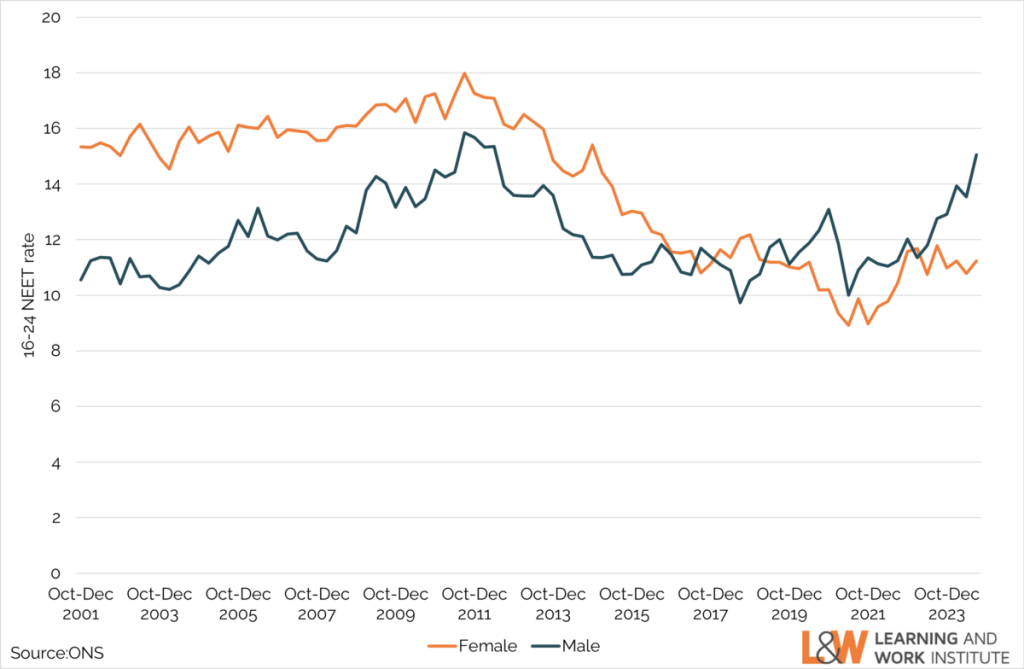
More fundamentally, we’d like to see the Youth Guarantee extended to cover 16–24-year-olds. There’s over 600,000 young people in this age group on Universal Credit (twice as many as 18-21 year olds) and likely (the data’s a bit dodgy) more than one million people not in work or full-time education all told (including those not on benefits), with recent rises starkest among young men.
Lastly, this is of course not the first Youth Guarantee (or similar) either in the UK or around the world. So we need to learn lessons from these other attempts. That’s something we’re looking at currently – watch this space for results.
What might success look like? A reduction in the NEET rate (our Youth Commission showed under 10% would be international best practice); reduction in inequalities in NEET rates between groups and areas; and young people spending shorter periods of time NEET.
We know what’s needed and we’ve got one million reasons to act.