
Responding to the latest NEET data released by ONS on 22 August 2024, Dr Helen Gray, L&W’s chief economist, said:
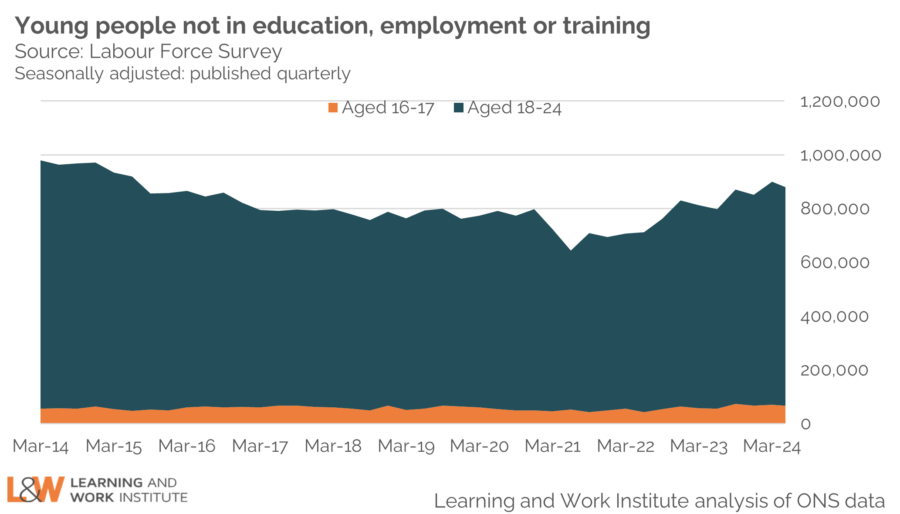
“Today’s release of quarterly figures from the Office for National Statistics show that an additional 74,000 young people are not in education, employment or training (NEET) compared with the same time last year. The number of young people who are NEET remains substantial, at 872,000. With many young people receiving GCSE results today and about to make the transition from secondary education, we continue to call for a Young Person’s Guarantee to offer a job, training place or apprenticeship to the 1-in-8 young people who are not in education, employment or training.”
Key findings
- 872,000 young people (aged 16-24) were not in education, employment or training (NEET) in the April-June quarter of 2024, an increase of 74,000 on the same quarter in 2023.
- 18-24 year olds make up the vast majority of young people who are NEET. There were 807,000 18-24 year olds who were NEET in the April-June quarter of 2024 compared with 65,000 of those aged 16-17.
- Between April-June 2023 and the same period in 2024 the percentage of 16-17 year olds who were NEET rose by 0.5 percentage points, from 3.6 per cent to 4.0 per cent. The percentage of 18-24 year olds who are NEET has risen by 1.1 percentage points from 13.5% to 14.5%.
- Young men are more likely to be NEET than young women. From those aged 16-17, 5.4% of men were NEET in the April-June quarter of 2024 compared with 2.6% of women. For those aged 18-24, 15.9 per cent of men were NEET compared with 13.1% of women.
- Among 16-17 year olds, the percentage of men who were NEET was 2.1 percentage points higher in the April-June quarter of 2024 than one year earlier. The percentage of women aged 16-17 who were NEET fell by 1.2 percentage points over this same period.
- The percentage of men aged 18-24 who were NEET rose by 1.7 percentage points between April-June 2023 and the same quarter in 2024. For women in this age range, the percentage who were NEET rose by 0.4 percentage points compared with one year earlier.
Subscribe to receive our monthly labour market analysis
Sign up to receive our monthly briefing delivered directly to your inbox.
Become a supporter