
The Government’s White Paper aims to chart a path toward an 80% employment rate. This briefing sets out five things you need to know about that plan, why it matters, and how success can be achieved.
1. An 80% employment rate needs 1.5-2.5 million more people in work, which can only be achieved by narrowing gaps between groups and areas
The Government is aiming for an 80% employment rate, taking up a Learning and Work Institute (L&W) recommendation. This would match world-leading countries like the Netherlands, is achievable given there are 3.2 million people who are out of work but want a job, and would boost the economy by more than £20 billion while saving the taxpayer £8 billion per year.
The main measure of employment, the Labour Force Survey, is suffering from low response rates so its estimates must be treated with caution. Administrative data suggest employment may be flat rather than lower than in 2019. Nonetheless, most data sources point to the UK being the only G7 country where employment isn’t higher than pre-pandemic.
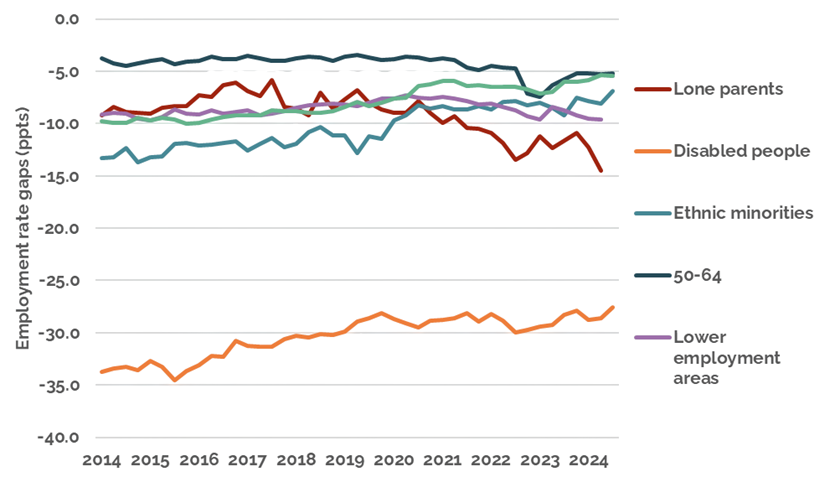
Large and persistent inequalities between groups and areas are holding back the overall employment rate (Figure 1). Closing the disability employment rate gap would mean an extra 2.4 million people in work, while closing the gap between the top 20% of local authorities with the lowest employment rates and the rest of the country would mean an extra 350,000 people in work.
Figure 1: Employment rate gaps
Source: Labour Force Survey and Annual Population Survey, 2024
2. 2.8 million people are economically inactive due to long-term sickness, up one third (671,000) since the pandemic
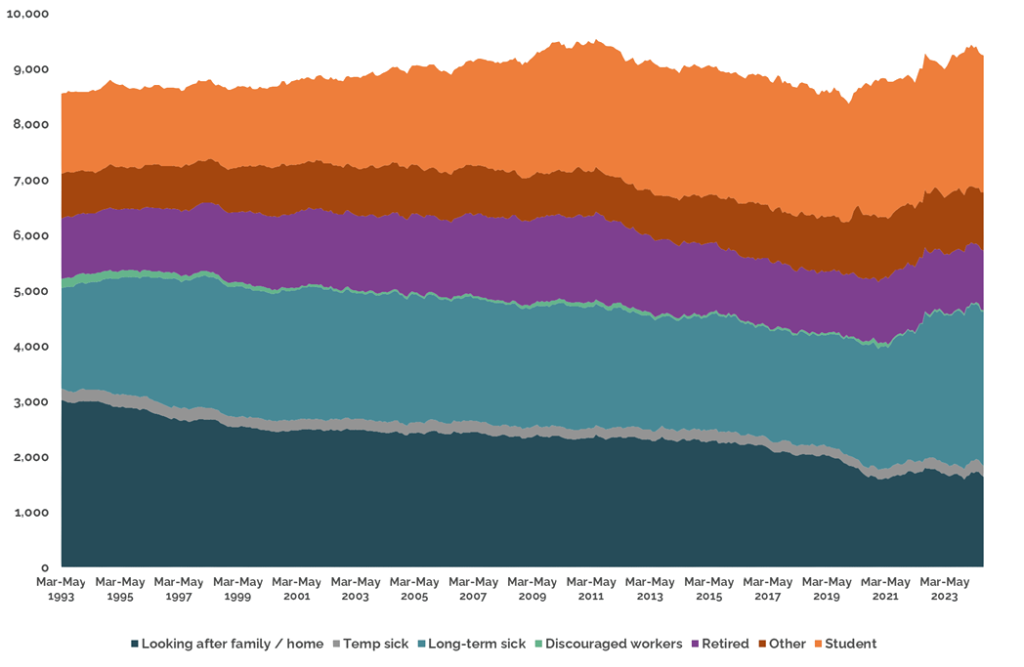
Until recently, the number of people economically inactive was falling (with the exception of students as higher education has expanded). Recent rises have been driven by increases in the number of people who are economically inactive (out of work and either not looking for or available to start a job) due to long-term sickness, taking the proportion of people economically inactive due to long-term sickness back to 2010 levels (Figure 2). Again, while there are doubts over the Labour Force Survey, administrative data on the number of benefit claimants (see next section) suggest the same picture.
Long-term sickness is what people give as their main reason for being economically inactive, there are likely to be other causes too (such as not thinking the jobs people want are available, lacking the skills for the work available, caring responsibilities etc). Policy needs to ensure people get the support they need on a personalised basis, rather than just focusing on a single issue such as health.
Figure 2: Economic inactivity by reason (thousands)
Source: Labour Force Survey, 2024
3. 2 million people are claiming out-of-work benefits due to sickness or disability, with the cost of in and out of work disability benefits projected to rise to £63 billion in 2028-29
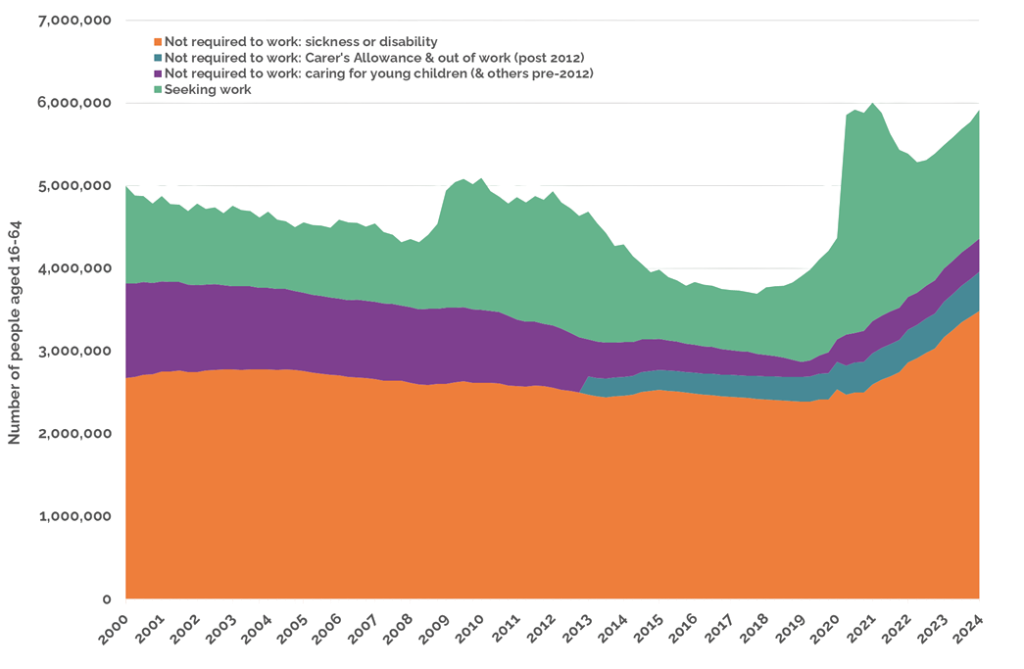
It is difficult to compare the number of people claiming different benefits over time, as the eligibility criteria vary so much. However, L&W estimates 3.2 million people are receiving out-of-work benefits and not required to look for work due to sickness or disability. Over time, more of these are claiming Universal Credit, but there are still significant numbers receiving ‘legacy benefits’ like Employment Support Allowance. The Government plans to complete the transition to Universal Credit by March 2026.
The number of people claiming out-of-work disability benefits was relatively flat (and therefore, as the population grew, a falling share of the population) during the 2010s (Figure 3). But it has increased by almost one million, (946,000, 37%) since the start of the pandemic. As a result of this and rises in claims for Personal Independence Payment (available for those in and out of work and intended to cover extra living costs associated with disability), the Office for Budget Responsibility (OBR) estimates the cost of disability benefits will continue to rise.
Figure 3: Out-of-work benefit receipt by main reason
Source: DWP StatXplore and ONS Labour Force Survey
4. Only one in ten out-of-work disabled people gets help to find work each year, and that support is less likely to be successful
L&W estimates only one in ten out-of-work disabled people and older people get help to find work each year. This is largely because most employment support, and requirements to look for work, are focused on those who are unemployed. For example, young people are three times more likely to get help to find work.
The benefit system and insufficient help for those outside particular categories of claimants are one of the root causes. When somebody is out of work due to a disability or health problem, they are referred to a Work Capability Assessment. This aims to assess whether they might be able to do some work either now or with support in the future. The result is that they are either placed in the ‘Searching for Work’ category (they are judged able to work immediately), ‘Limited Capability for Work’ (no extra payment, can undertake some work preparation but not able to work immediately), or ‘Limited Capability for Work and Work-related Activity’ (extra payment, not able to work or prepare for work).
Little support to find work is offered to those in either of the ‘limited capability’ groups or those who are out of work but not on benefits. This has begun to change somewhat with some UK Shared Prosperity Fund provision (though this is smaller than the previous European Social Fund) and DWP programmes like Universal Support (though this is running behind schedule). What support there is tends to get poorer results than employment support for disabled people, and work, health and skills are too often disjointed.
Helping people stay in work is as important as help people who are out of work to find a job. Previous research has suggested more support is needed to help employers, particularly small employers, to better support and retain people who are disabled or who develop disabilities while in work. This includes expanding access to occupational health support, and also ensuring people and employers are aware of Government-funded support like Access to Work. Access to Work can pay for reasonable adjustments, but its budget and awareness of it can be limited, and groups have highlighted significant delays in making decisions.
5. Fourteen times as many people are economically inactive due to long-term sickness in some parts of the country compared to others
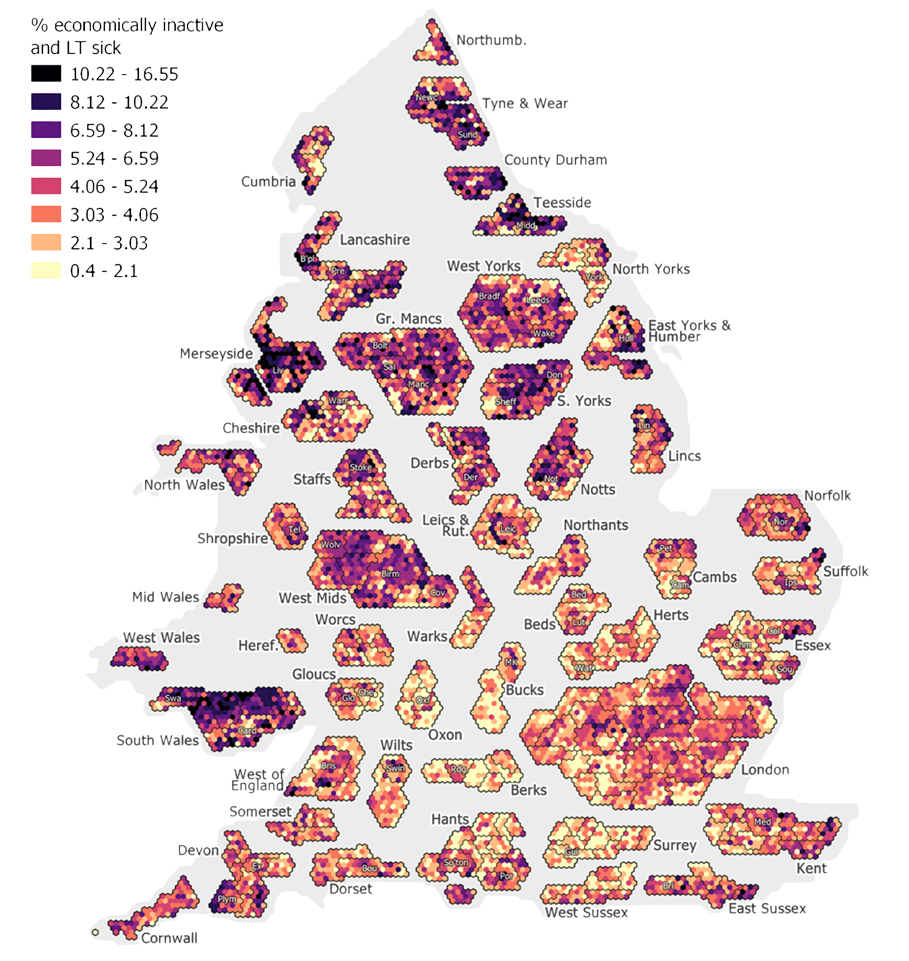
According to the 2021 Census, in parts of Surrey, just 1 in 100 people are economically inactive due to ill health (Figure 4). In contrast, in some parts of Merseyside (or Liverpool City Region) 1 in 7 people are economically inactive due to long-term sickness. This means support and policy needs to be tailored to local circumstances, pointing to an important role for local leaders.
Figure 4: Share of 16+ population economically inactive due to long term sickness, 2021
Source: Census 2021
We need to get better help to more people, implement a Youth Guarantee, and ensure employers open up their recruitment processes and focus on healthy workplaces.