Driving Change in Higher Education
Our Driving Change in Higher Education (HE) project is working with universities across England to review and improve the support they offer to young adult carers. The project offers support, free of charge, for each university to develop and embed support that will make a difference for young adult carers.
Young adult carers are young people, aged 16 to 24, who provide unpaid care to a family member on a regular basis. L&W estimates that young adult carers provide over £3.5 billion of unpaid care per year. Despite this, on average they achieve 9 lower GCSE grades than their peers, they are five times more likely to drop out of college, and they are 38% less likely to achieve a degree qualification. However, these outcomes are not inevitable.
These young people deserve to go as far as their talent and hard work will take them, yet our work and wider research shows that they often don’t feel supported to go to university. Findings from UCAS in 2024 show that almost two thirds (63%) of young adult carers say they did not receive support tailored to their circumstances to apply for HE, and 69% were unaware of the support available for students with caring responsibilities at their university.
We want to break down barriers to HE and ensure that young adult carers have the same opportunities to go to university, and achieve their potential, as other young people.
Supporting young adult carers in higher education
Delivered in partnership with Carers Federation, and supported by The National Lottery Community Fund, The Driving Change in HE project aims to:
- Support successful access and transition to HE for young adult carers
- Improve the support they receive in HE, ensuring that they have a positive experience of university and the same opportunity as their peers to fulfil their potential and achieve better outcomes.
Universities on Driving Change in Higher Education

Starting in April 2024, the project will work with 25 universities over three years. The actions of an initial cohort of Driving Change universities are already having an impact ensuring that the support they offer really meets these young people’s needs. This includes:
- Introducing new processes to improve early and ongoing identification of students with caring responsibilities so that support can be offered as they start university
- Offering specific packages of financial support, such as bursaries
- Production of a young adult carers/carers policy or incorporation of young adult carers into other key policies
- New awareness raising activities which mean that academic and support staff better understand and feel more confident in supporting this group of students.
- Better join-up with local carers services, for example to run specific young adult carer events, is helping young adult carers and their families to identify that the university is carer friendly, encouraging them to consider an HE pathway and helping to support their transition from further education to university.
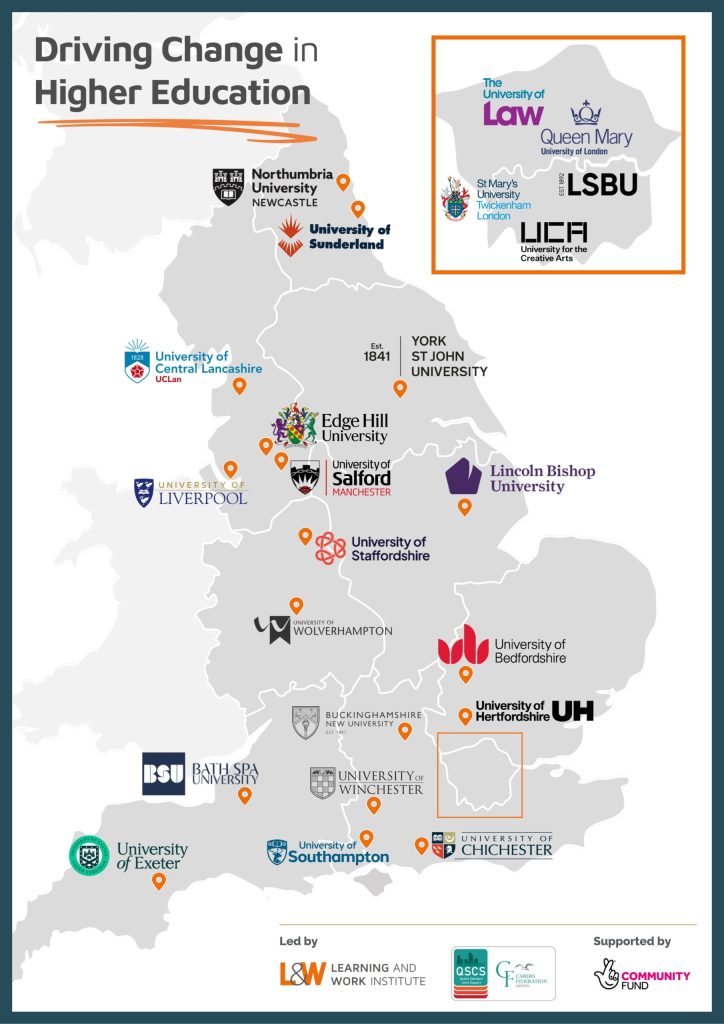
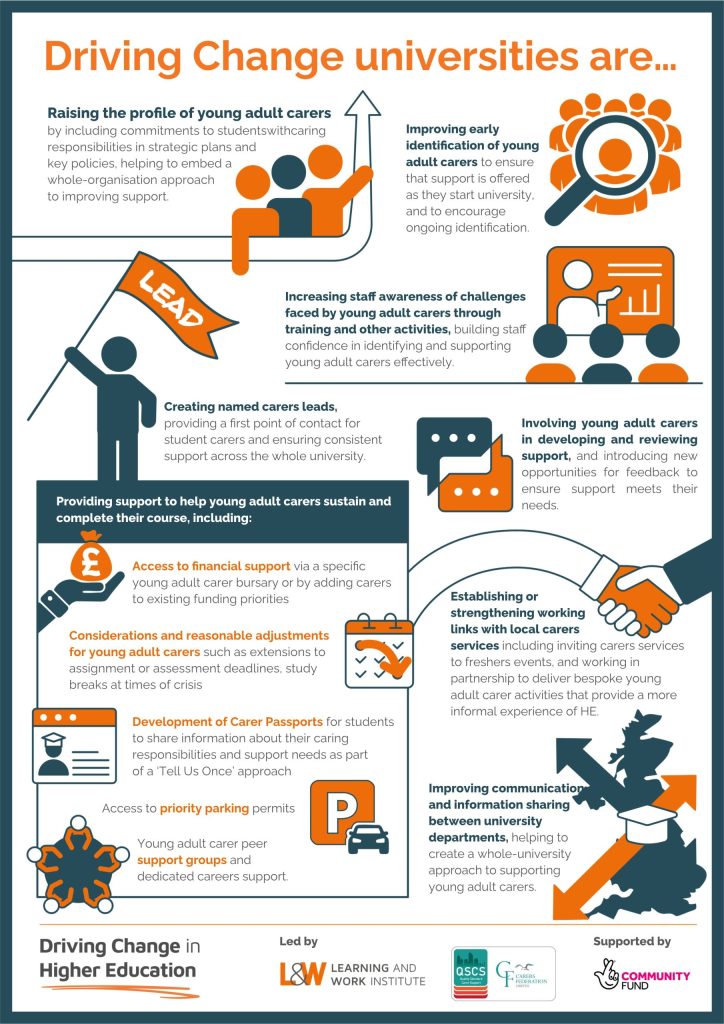
Download our infographic
This infographic shows the measures Driving Change universities have taken to improve support for young adult carers
See more
1 May 2026
Driving Change in Higher Education
Learning and Work Institute is working in partnership with The Carers Federation with funding from The National Lottery Community Fund to improve the support that young adult carers receive in higher education.
12 March 2025
Making a difference for young adult carers in higher education
Young adult carers are 38% less likely to gain a degree qualification than other young people – but recent research from UCAS shows that many young adult carers still aspire to university. As Jackie Woodhouse, Research Manager at Learning and Work Institute writes, this should be a wake-up call for the higher education sector.
21 November 2024
“I returned that evening with a renewed sense of purpose and passion to advocate for young adult carers within my university.”
To mark Carers Rights Day 2024, young adult carer Holly reflects on her experience meeting Her Royal Highness The Princess Royal.
21 November 2024
“Being a carer has been a part of my identity for as long as I can remember. But until the age of 18, I didn’t know that this role even had a name.”
To mark Carers Rights Day 2024, young adult carer Farzana reflects on her right to an education and support – and how it can be difficult to recognise your rights without recognition for your caring role.
21 November 2024
“Although it was always my desire to continue my studies in higher education, without the support I received I’m not sure that I would have got so many offers.”
To mark Carers Rights Day 2024, young adult carer Kelly looks back on the crucial support she received from her college and local carers centre.
23 November 2023
“No young adult carer should miss out on learning because they care for their families. We are writing to call on you to exempt young adult carers from the 21 hour rule.”
To mark Carers Rights Day 2023, L&W and Carers Trust published an open letter calling on the Secretary of State for Work and Pensions to exempt young adult carers from the 21 hour rule in the benefits system.
8 June 2023
Young adult carers and the 21 hour rule
This policy briefing calls for young adult carers to be exempt from a rule in the benefit system which means that they cannot claim Carer’s Allowance if they study for more than 21 hours per week.
5 June 2023
We still care
Following the conclusion of Move On Up, a six-year housing pilot between Commonweal Housing and Quaker Social Action, this report warns that unpaid carers aged 16-25 face potential homelessness unless their housing needs are urgently met with policy.
10 June 2020
Move On Up
Learning and Work Institute evaluated the delivery of Move On Up, a housing and support project for young adult carers, delivered by Quaker Social Action (QSA) in partnership with Commonweal Housing.
28 April 2020
Driving Change – supporting young adult carers in further education
Learning and Work Institute worked in partnership with The Carers Federation to improve the support that young adult carers receive in further education.